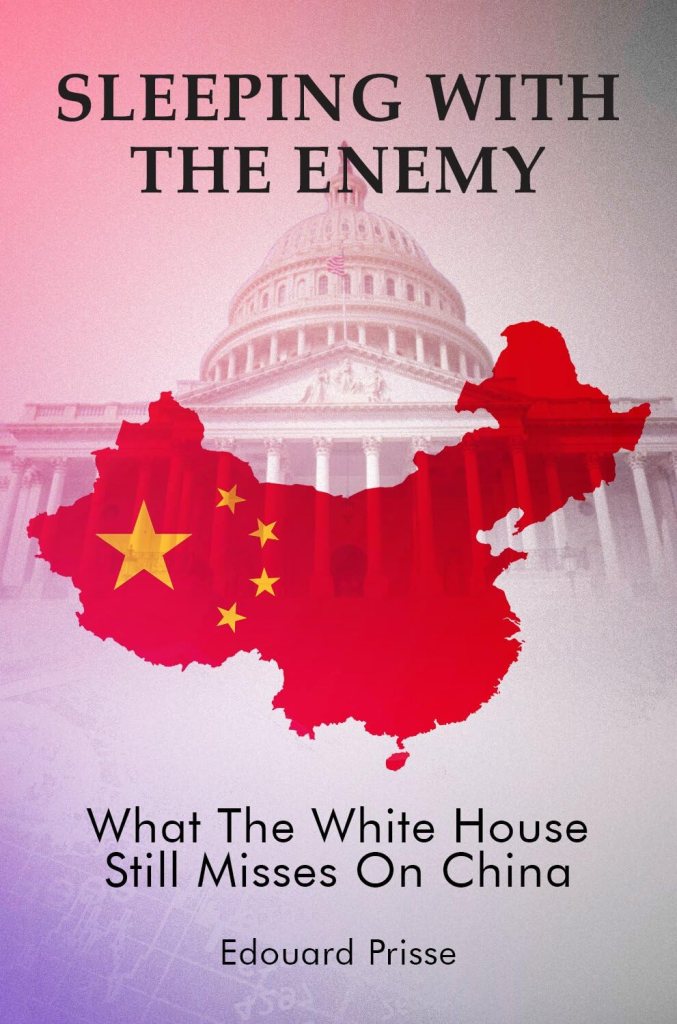
Book Details:
Author: Edouard Prisse
Release Date: 25 March, 2026Series:
Genre: Macroeconomics, International & World Politics, Economics
Format: E-book
Pages: 147 pages
Publisher: –
Blurb:
A Wake-Up Call for the West
For decades, Western leaders assumed that deeper economic integration with China would produce stability, openness, and shared prosperity. Instead, those policies helped accelerate China’s wealth accumulation and strategic leverage.
In Sleeping With the Enemy: What the White House Still Misses on China, independent political observer Edouard Prisse examines the political, economic, and media assumptions that shaped Western policy toward China—and the consequences of those assumptions today.
This book argues that prevailing free-trade orthodoxies and elite consensus have obscured the long-term risks of economic dependence. By revisiting the decisions, predictions, and narratives that shaped public understanding, Prisse challenges readers to reconsider what the West believed about globalization—and what those beliefs may have cost.
Review
Sleeping With The Enemy by Edouard Prisse is a forceful, politically charged work of economic argumentation centred on the urgent claim that the West, particularly the United States, made a grave strategic error when it opened free trade with China in the early 2000s, and that this error has allowed China to grow into a far more dangerous economic and geopolitical power than Western leaders seem willing to admit. From the foreword itself, author Prisse is clear about the book’s purpose: to identify the original mistake, explain the current consequences, and propose a corrective strategy he calls the “Six-Month Moratorium.”
What makes the book compelling is not subtlety, but conviction. Prisse writes with the urgency of someone who believes he saw the danger long before others did, and the manuscript repeatedly returns to two formative experiences: his earlier prediction regarding economic collapse in former East Germany after reunification, and his later concern that China’s low-cost production structure would create a dangerously one-sided trade relationship. Whether one agrees with all of his conclusions or not, there is no denying the clarity of his central thesis: he believes the West is not merely buying cheap goods from China, but helping finance the rise of a rival power.
The strongest sections of the book are those dealing with macroeconomic imbalance. Prisse’s argument that China’s vast foreign exchange reserves and continuing trade surpluses have given Beijing extraordinary geopolitical leverage is presented with intensity and purpose. He connects trade, industrial decline, political influence, Taiwan, Europe’s weakness, and China’s global ambitions into one broad strategic framework. The book is at its best when it focuses on this larger pattern rather than isolated outrage. His proposed solution of replacing free trade with “Equal Trade” after a carefully prepared six-month transition is ambitious, provocative, and certainly more structured than a simple call for tariffs.
That said, this is also a book that demands a critically alert reader. Its tone is sometimes sweeping and occasionally overconfident in its judgments of individuals, institutions, and nations. Some claims, particularly around a perceived Chinese “fifth column” influencing American thought, are presented more as inference than demonstrable fact, and readers may rightly want stronger evidence before accepting such serious assertions. The book’s political framing, especially its praise of Donald Trump’s instincts alongside criticism of his advisers, will also divide readers depending on their own political and economic perspectives.
Stylistically, the manuscript is direct, argumentative, and personal. It reads like an urgent intervention and that gives it energy, but also creates unevenness. There are moments when the repetition strengthens the warning, and others where the book might have benefited from tighter editorial control and a more measured rhetorical register. Still, the author’s sincerity and sense of intellectual responsibility come through strongly.
Overall, Sleeping With The Enemy is a bold and deeply opinionated book about trade, China, Western complacency, and the future of democratic power. It is not a light read, nor a detached one, but it is intellectually provocative and designed to provoke debate. Readers interested in China, global trade, U.S. strategy, and the economic roots of geopolitical power will find much here to engage with, even when they disagree.


I love reading your comments, so please go ahead…