Welcome to TRB Lounge. Today, I’d like to welcome Luanne Castle, author of Scrap: Salvaging a Family, for an author interview with The Reading Bud.
About The Author
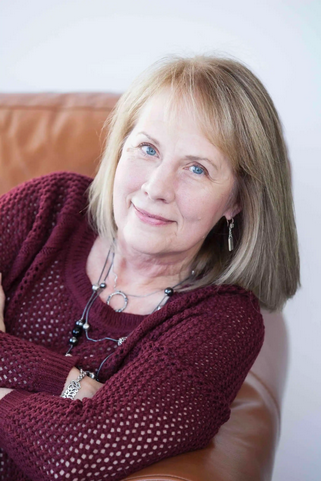
Luanne Castle
Luanne Castle’s hybrid flash memoir, Scrap: Salvaging a Family, with a starred Kirkus review, is available from ELJ Editions. Her story, “Garden Seasons,” was selected for Best Microfiction 2026. Her poetry and prose have appeared in Copper Nickel, River Teeth, Your Impossible Voice, JMWW, Grist, Fourteen Hills, Verse Daily, Disappointed Housewife, Lunch Ticket, Saranac Review, Pleiades, Cleaver, Moon City, Moon Park, Anti-Heroin Chic, Bending Genres, BULL, The Mackinaw, The Ekphrastic Review, Phoebe, MacQueen’s Quinterly, Gone Lawn, Burningword, Superstition Review, One Art, Roi Fainéant, Dribble Drabble, Flash Boulevard, O:JA&L, Sheila-Na-Gig, Thimble, Antigonish Review, Longridge, Paragraph Planet, Six Sentences, Gooseberry Pie, Switch, and Ginosko.
She has published four award-winning poetry collections. Her ekphrastic flash and poetry collection Hunting the Cosmos is forthcoming from Shanti Arts in fall 2026. Her mixed-media art has been showcased at Rogue Agent, Ink in Thirds, Watershed Review, Wildscape, Mad Swirl, Raw Lit, and Thimble.
Luanne has been a Fellow at the Center for Ideas and Society at the University of California, Riverside. She studied English and Creative Writing at the University of California, Riverside (PhD); Western Michigan University (MFA); and Stanford University (Certificate). Luanne lives with her husband and three cats in Arizona along a wash that wildlife use as a thoroughfare.
You can find author Castle here:
Website
Interview
Welcome to TRB! Beyond the formal details in your Author Bio, could you share a more personal glimpse into who you are with our readers?
I grew up in Kalamazoo, Michigan, where I earned an MFA, then moved to California with my husband and two young children to study for my PhD in English. After that I taught at a university half-time and worked in my husband’s dental marketing business. When I took early retirement for medical reasons, we moved to Arizona, and I began to write my memoir. That’s when I got a certificate in creative nonfiction/memoir from Stanford University’s online program.
My kids are both married and live near my husband and me. We have a two-year-old grandson. During Covid I started art journaling which led to mixed media collaging. My collages have been featured in a number of magazines. I’m a dedicated animal lover and currently have three cats.
Beyond the blurb, could you delve into some unique aspects or pivotal moments from your book?
A pivotal time was when I was getting ready for ballet and, as usual, had picked up a book to read. My father stopped by to see if I was ready yet, and without thinking I asked the question I’d never thought of before: where is your father? My father’s response shut down our communication on the subject for fifty years.
What drove you to explore this specific theme in your book? Is there a central message or insight you aim to convey to your readers?
When I started writing Scrap: Salvaging a Family I didn’t know of any message. I just wanted to share my experiences and, through writing about them, learn from them. But my story began to shape itself by the real-life events that occurred, and after my father passed away, I realized that I was writing about forgiveness—the human desire to forgive one another and ourselves.
Evey book has its roots. What served as the catalyst for this one—a personal experience, a persistent idea, a transformative event, or something else entirely?
Most likely the catalyst was the big gap in my life. Until my father was elderly I had no idea who his father was and this felt like a big hole in my own life.
How long was the journey from conceptualizing the idea to seeing the final version of this book?
Eighteen years of writing, writing, writing. This book took many different shapes before I landed on the final structure.
As a writer, what are your future aspirations? Where do you envision yourself in the literary world five years from now?
Scrap is my fifth book, and I have a collection of ekphrastic poetry and flash fiction inspired by the art of Spanish-Mexican artist Remedios Varo called Hunting the Cosmos forthcoming from Shanti Arts later this year. I don’t feel another book in me right now, but that could change. So, for now I will continue to write flash and poems. I have no desire to write a novel, although I have three unfinished plays and a couple of other partial projects. Maybe I’ll go back to one of those. I like to support other writers through writing reviews and sharing their work with others.
Are there other topics or projects you’re currently researching or writing about?
I’m between major projects right now, but that doesn’t mean I’m not writing. And reading.
While your focus is on non-fiction, have you ever been tempted to venture into the realm of fiction?
I write a great deal of flash fiction. My MFA in creative writing was actually split between poetry and fiction. I studied under Stuart Dybek for fiction. My first four books are poetry.
Can you recall the moment when you realized you wanted to be a writer? Was it a path filled with challenges or a passion you seamlessly transitioned into? Our readers cherish personal author journeys!
When I was a little girl I wanted to be the three As: author, actress, and archeologist. I think of writing as having achieved all of those goals. Author is obvious, archeologist is related to the research for writing, and acting is important to me because I absolutely love writing different voices. Although I worked on my MFA when my kids were very little, after I moved and started my PhD, I had too much going on to write. I was studying, teaching, working for my husband, and taking care of the kids while my husband traveled for business. Even so, I would write like fury every few months for a month or two, just to keep my hand in it. That’s why when I was forced to retire from teaching (but still working for the business) I started writing: memoir and poetry. The flash fiction came a bit later.
Describe your writing process. Do you have any routines or rituals that help you stay focused and inspired?
I do love taking workshops. My husband jokingly calls me a “professional student.” The constraints involved with writing to prompts assigned by someone else stimulate my imagination and keep me focused so that I don’t have too many decisions to make. The routine is to sit in front of the computer and start writing when I can find at least a half hour. Kitchen or office, it doesn’t matter, although the kitchen is easier because I can keep an eye on what else needs doing. I’ve never really had long periods of solitude to write. Maybe that’s why I tend to write poetry and flash.
Outside of writing, do you have another profession or area of expertise?
I’m ok with general office work. I don’t love it, but I’ve done it for so long I have more expertise than the average person. I am an excellent reader. And my favorite area of (pseudo) expertise has been being a mom and now a grandma.
Given the theme of your book, could you recommend one or two other reads that resonate with similar ideas or insights? Feel free to mention influential authors as well.)
Mary Karr’s The Liar’s Club and Bernard Cooper’s The Bill from My Father were important traditional memoirs for me because of the focus on the relationship of the writers with one or both parents. It was harder to find less traditional memoirs to read, but I was influenced by Sheila O’Connor’s Evidence of V and Helie Lee’s Still Life with Rice. Both of these books are recreations of their grandmother’s lives. Another book that does something similar is Half-Broke Horses by Jeannette Walls. However, the only one of these books that works in hybridity is the O’Connor book.
In the vast realm of non-fiction, are there specific authors or books that have profoundly influenced your approach or thinking?
The above authors were most influential for me.
The dreaded Writer’s Block—does it ever hinder your process, and if so, how do you navigate past it?
I’ve never had Writer’s Block. The closest I’ve come are periods where I am overwhelmed with too much work and stimulation. At those times I can’t calm my mind enough to write, so I have to wait it out. I do think the reason I don’t experience Writer’s Block is my reliance on prompts for writing. Focusing on a specific topic/structure/style gives me the ability to move forward with a particular story or poem.
Non-fiction often requires a balance of research and narrative. How do you strike that balance, ensuing your work is both informative and engaging?
I did research for Scrap, but the majority of it was genealogical research. I ended up not including too much of that in the book but it underpins the search for understanding my grandfather. I was an academic writer for some time, and so my experience with researching for writing probably comes in handy. When you write memoir, it’s important not to let the research overwhelm the emotions.
Writing non-fiction can sometimes mean delving into controversial or sensitive topics. How do you handle potential criticism or differing viewpoints from readers?
In memoir, the writer runs the risk of readers reading their own experience into the book, thus coloring their perspective. Additionally, some family members might not appreciate family secrets being divulged publicly. I have tried to be true to my own experience. That’s the best I can do.
For those looking to embark on their own non-fiction writing journey, what piece of advice would you deem invaluable?
My advice is to write in scenes without trying to publish them long enough to really get familiar with your own experience. Then write reflection pieces for each scene. In that way you discover what you have learned from the experience. All memoir is experience (memory) + reflection. You can’t have one without the other.
Thank you, author Castle, for taking the time to answer our questions and for all your insightful answers!
About the Book
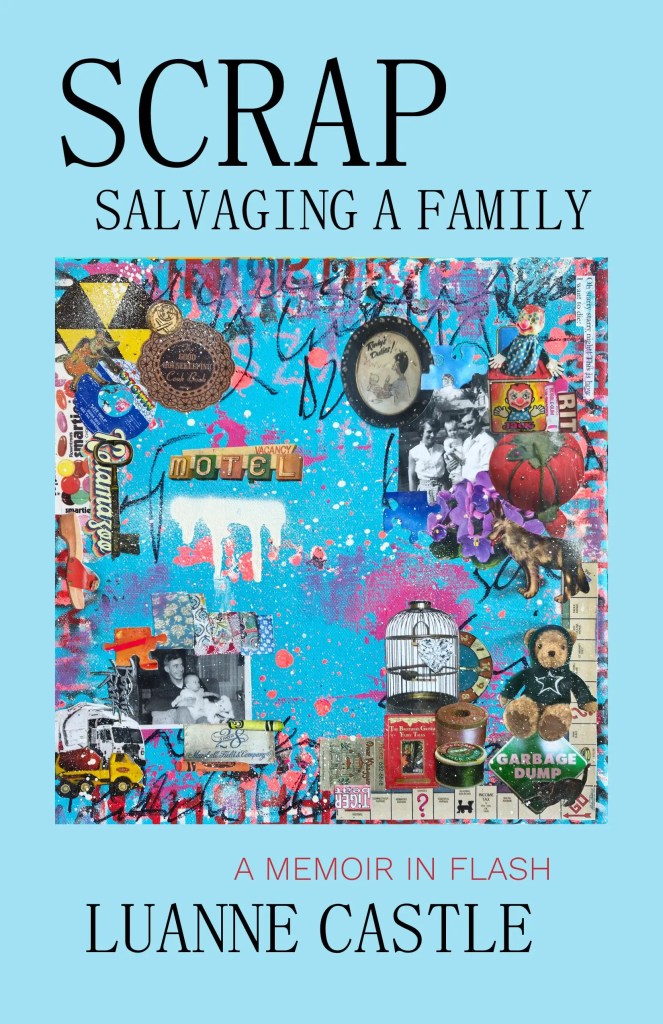
The Orichalcum Crown
Scrap: Salvaging a Family by Luanne Castle is a fragmented, lyrical, and emotionally precise memoir that sifts through family memory, inherited shame, childhood fear, and the difficult work of understanding a parent without excusing the harm they caused. Written as a “memoir in flash,” the book is built out of short, vivid pieces, named as scraps of childhood, domestic scenes, remembered violence, questions, photographs, family stories, documents, and imagined reconstructions, all stitched together into something devastating and incredibly artful.
At the centre of the memoir is Castle’s father, Rudy, a man carrying the wound of being born “illegitimate,” by the absence of his own father, and by the shame that surrounded his origins. But Castle does not simplify him into villain or victim. He is frightening, volatile, sometimes cruel but he is also resourceful, hardworking, wounded, loving in broken and bewildering ways, and capable of gestures of strange tenderness. This complexity is what gives the memoir its emotional maturity. Author Castle is not writing to settle a score; she is trying to understand the system of hurt that made her father who he was, and how that hurt passed through him into her childhood.
The form of the book is one of its strongest elements. The flash structure mirrors the nature of memory itself as nonlinear, sensory, sharp-edged, and sometimes contradictory. Author Castle’s prose is beautifully controlled, often poetic without becoming ornamental. She has a remarkable ability to locate trauma in objects. The title Scrap is perfect because the memoir is not only about salvage in the literal sense, but about salvaging meaning from what was damaged, hidden, discarded, or misunderstood.
What I admired most is the book’s refusal to offer easy forgiveness. It moves toward compassion, yes, but not sentimental absolution. Scrap is a beautifully crafted and intelligent memoir about trauma, inheritance, girlhood, secrecy, and family wounds. It is painful, yes, but also tender in unexpected ways. It is a memoir that feels intimate, brave, and unforgettable.
You can find Scrap here:
Amazon | Goodreads
If you are an author and wish to be featured as our guest or if you are a publicist and want to get your author featured on TRB, then please get in touch directly by e-mail at thereadingbud@gmail.com


I love reading your comments, so please go ahead…