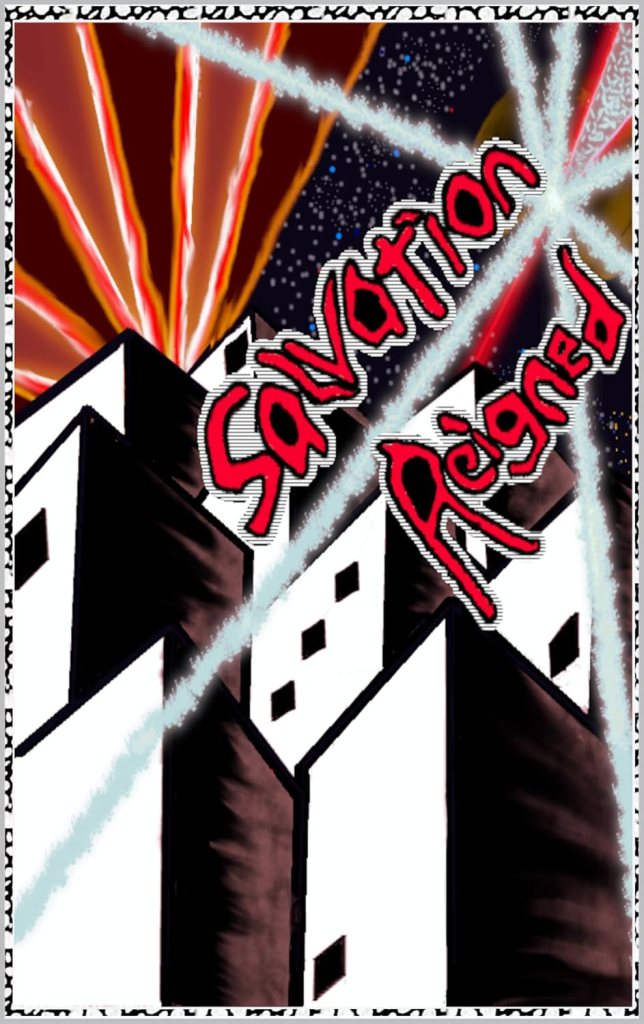
Book Details:
Author: Travis Peterson
Release Date: 31 March 2026Series:
Genre: Dystopian, Post-Aplocalypse, Sci-Fi
Format: E-book
Pages: 120 pages
Publisher: –
Blurb:
A rogue planet is coming. Humanity’s last city has a plan. You won’t like it.
Pete wakes in POD 217 with blood on his face and no memory of yesterday. The Last Great City is clean, pleasurable, and perfectly controlled — as long as its citizens follow the cycle. Reset. Comply. Repeat.
Pete keeps failing the reset.
Somewhere in the city, a woman named Marla is looking for him. Somewhere in the past, two scientists just watched something enormous pass in front of Betelgeuse. And somewhere at the edge of a dying wasteland, a cybernaut older than civilization is sitting under a cherry tree, watching the feral descendants of humanity dance under a dying star.
Salvation Reigned moves across fractured time and colliding perspectives — the scientists who saw it coming, the city that chose control over truth, the lovers whose bond survives every attempt to erase it, and the machine left behind to witness what persists when everything else is gone.
Raw. Nonlinear. Uncompromising.
This is not a story about heroes. It is a story about what love, memory, and consciousness do when a system tries to delete them.
Adult content: extreme language and graphic violence.
For fans of Philip K. Dick, Chuck Palahniuk, and Jeff VanderMeer.
Review
Salvation Reigned by Travis James Peterson is a strange, abrasive, darkly comic work of dystopian science fiction that reads like the end of the world filtered through panic, intoxication, political theatre, body horror, and cosmic absurdity. The novel begins with Pete, a scientist working on a singularity weapon to stop Nyx, a rogue planet on a collision course with Earth, but very quickly expands into something much wilder: a collapsing civilisation, performative leadership, feral evolution, cybernauts, strongholds, memory cycles, and the unsettling question of whether “saving humanity” means anything if humanity has already lost itself.
What immediately stands out is the book’s voice. It is raw, fragmented, profane, hallucinatory, and deliberately excessive. Author Peterson writes in short bursts that feel part fever dream, part stand-up routine, and part apocalypse sermon. This style will not be for everyone, but it gives the novel a distinctive pulse. The political satire is especially sharp in the early sections, where the President, his cabinet, and the media apparatus respond to planetary extinction with ego, spectacle, branding, and grotesque public performance. The discovery of Nyx by Gilbert and Lewis, followed by the government’s attempt to control the narrative, sets the tone beautifully: this is a world too stupid, vain, and overstimulated to face its own ending with dignity.
Thematically, the novel is surprisingly rich beneath its chaotic surface. It is deeply concerned with survival, control, memory, bodily autonomy, propaganda, technological salvation, and our recurring instinct to turn even catastrophe into hierarchy. That said, Salvation Reigned is not a smooth or conventionally polished read. Its intensity can become overwhelming, and the constant barrage of profanity, sexual imagery, violence, and surreal humour may exhaust some readers. The prose is intentionally jagged, but there are moments where that jaggedness blurs clarity. Readers looking for traditional pacing, clean exposition, or restrained dystopian storytelling may struggle with it. However, readers who enjoy experimental speculative fiction, satirical apocalypse narratives, and fiction that is willing to be ugly, funny, clever, and uncomfortable all at once may find this book fascinating.
Overall, Salvation Reigned is bold, chaotic, and extremely strange in a way that feels entirely intentional. It is not simply about stopping the apocalypse; it is about what people do when extinction becomes a certainty, and how every system (political, technological, spiritual, and biological) tries to claim the right to define survival. It is messy, provocative, and often grotesque, but it also has flashes of real beauty, especially in its final meditation on memory, destruction, and the life that continues after us.


I love reading your comments, so please go ahead…