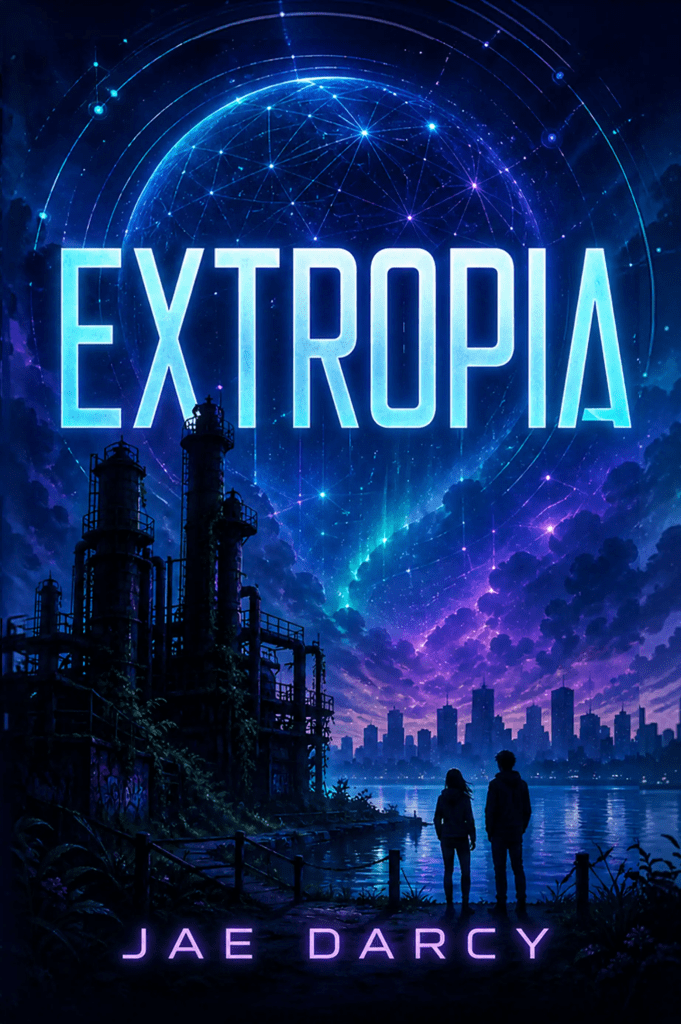
Book Details:
Author: Jae Darcy
Release Date: 1 May 2026Series:
Genre: Young-Adult, Science-Fiction, Dystopia, Cyberpunk
Format: E-book
Pages: 407 pages
Publisher: Pomegranate Seed Press
Blurb:
In 2164, reality is something you can buy. The wealthy live online in a gleaming virtual world wired directly into their bodies from birth. Those left outside keep the lights on in an abandoned world.
Bache Parker is eighteen, exiled, and forgotten. His bioware was destroyed in a hack gone wrong, and now he spends his days tending the comatose bodies of people living the life he lost. When a blind girl from a neo-Luddite community asks him to help deliver a virus that will bring the Inside crashing down, he should walk away.
He doesn’t.
Ayven Reynolds has never seen the Inside. She’ hasn’t seen anything at all, until Bache wires her in, and the world her people call an abomination gives her back her sight. Now the virus is live, the stakes are real, and everything both of them thought they believed is suddenly negotiable.
Extropia is a YA cyberpunk novel about power, identity, and what it costs to see the world clearly — even when you’ve been blind your whole life.
Review
Extropia by Jae Darcy is an ambitious, emotionally charged sci-fi dystopian novel set in a future where humanity has split itself between the physical world and the seductive virtual realm known as the Inside. In 2164, the world outside has decayed into poverty, surveillance, abandoned cities, religious resistance movements, and corporate control, while the wealthy and privileged live much of their lives inside sensory tanks. Against this sharp divide, author Darcy builds a story that is part cyberpunk adventure, part political rebellion, part coming-of-age drama, and part tender, slow-burning romance.
The novel follows two beautifully contrasted protagonists: Bache Parker, a gifted former hacker whose access to the Inside has been destroyed after a disastrous raid, and Ayven Reynolds, a blind sixteen-year-old from a New Green commune in the Cascade Mountains. Bache is bitter, funny, wounded, reckless, and deeply lonely; Ayven is brave, perceptive, principled, and far less fragile than the world around her assumes. Their first meeting itself sets the tone for one of the book’s strongest elements: the gradual, electric, emotionally complicated trust that develops between them.
What stands out most is the worldbuilding. Author Darcy’s future Seattle is vivid and cinematic with tank towers, Bootjack patrols, abandoned districts, underground routes, access decks, meat-minders, body tanks, hackers, New Greens, and the wealthy Avar society of the Inside. The contrast between Ayven’s mountain world and Bache’s decaying city world gives the novel a strong ideological tension. Neither side is treated as wholly pure. The Inside offers beauty, safety, pleasure, and freedom from bodily limitation, but it also enables abandonment, inequality, and disconnection from the dying physical world. The New Greens value nature, community, and embodiment, but their society also contains patriarchy, coercion, secrecy, and fanaticism.
Bache and Ayven are the emotional heart of the novel. Their bond works because it is not instant perfection. It begins with suspicion, betrayal, practical necessity, and ideological disagreement before becoming intimate. Bache’s cynicism meets Ayven’s moral seriousness; Ayven’s sheltered certainty meets Bache’s painful knowledge of systems, power, and compromise. Their conversations about reality, illusion, the body, technology, nature, and freedom are some of the book’s most thoughtful passages.
The secondary characters are also strong. Dex and Sarna bring history, loyalty, guilt, and urgency to Bache’s arc, while Seth and Elijah complicate Ayven’s world in very different ways. Elijah, in particular, is an effective antagonist because he wraps control in the language of faith and collective duty. Billy Severn’s presence adds another layer of menace, connecting personal grievance to large-scale violence. Linus Ross and NeuroGen, meanwhile, deepen the book’s critique of corporate power, inherited privilege, and the myth of technological salvation.
That said, Extropia is a substantial read. The book is long, dense, and structurally expansive, with many moving parts: political history, hacker mythology, tank technology, religious ideology, romance, pursuit, rebellion, and corporate conspiracy. Readers looking for a lean, fast sci-fi thriller may find the pacing deliberate in places, especially where the novel pauses to explain the mechanics of the Inside or the political situation outside it. However, for readers who enjoy immersive speculative fiction with emotional stakes and layered worldbuilding, that density becomes part of the appeal.
Overall, Extropia is a compelling, richly imagined, and emotional dystopian sci-fi novel. It combines cyberpunk atmosphere, ecological anxiety, class conflict, forbidden romance, and questions of identity into a story that feels both intimate and large in scope.








 The Reading Bud