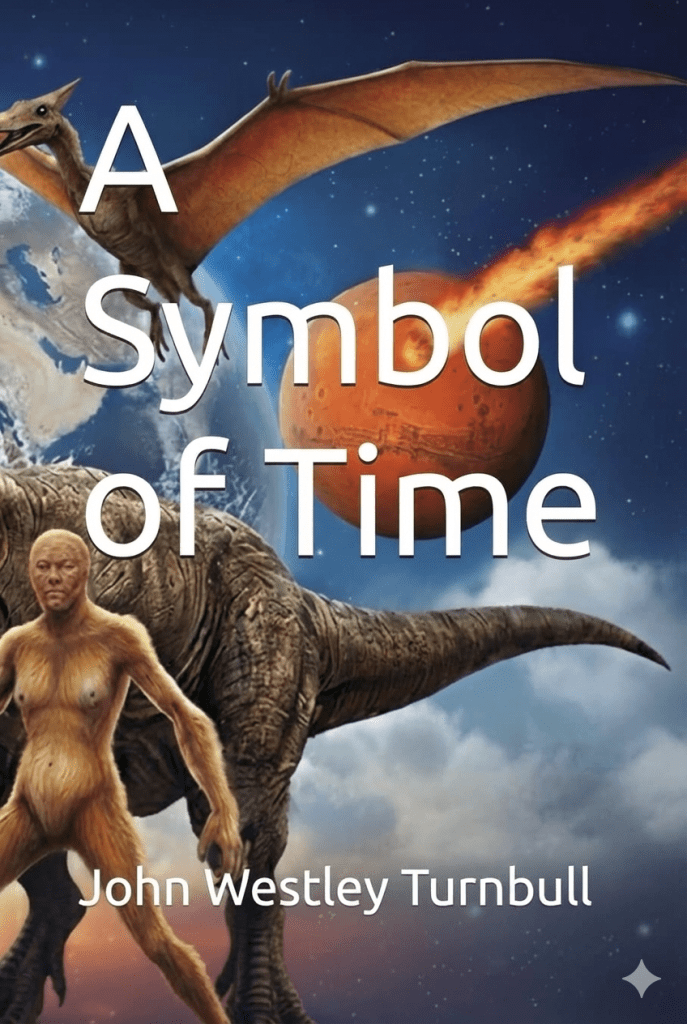
Book Details:
Author: John Westley Turnbull
Release Date: 14 November, 2025Series:
Genre: SScience-Fiction, Dystopian, Alternate History
Format: E-book
Pages: 243 pages
Publisher: –
Blurb:
Survival requires sacrifice. But what if the price is an entire world?
Their home is cold and dying, choked by the toxins of their own progress. Now, an advanced alien species looks toward the Third Planet—Earth—with hope and fear. They see a fertile paradise, but one that is hostile, hot, and dominated by massive, predatory reptiles.
The choice is stark: die in the heat, or remake this new world in their own image.
As they descend to alter the climate and purge the planet of its prehistoric masters, they set in motion a chain of events that will echo through geological time. A Symbol of Time weaves palaeontology and astronomy into a chilling tale of survival. As the new masters of Earth terraform the planet, the question remains: does high intelligence inevitably carry the seeds of its own destruction?
Review
A Symbol of Time by John Westley Turnbull is a haunting speculative fiction that begins with exhaustion, opening on a dying Homeworld, where the last surviving inhabitants of a once-thriving civilisation are forced to abandon their planet and seek refuge on the “Third World,” a beautiful, brutal, water-rich planet teeming with monstrous life. From the very beginning, the novel positions itself as more than a survival story; it is a meditation on ecological ruin, migration, leadership, memory, and the dangerous arrogance of believing that survival justifies everything.
What I found most compelling is the moral tension at the heart of the book. Elthyris begins as a determined leader trying to save her people from extinction, but as the colony reaches the Third World, her decisions grow increasingly severe. The novel does not present colonisation as a clean heroic act. Instead, it asks difficult questions like when does adaptation become domination? When does necessity become cruelty? And how easily does a displaced civilisation carry the seeds of its old destruction into a new world? This gives the book its strongest intellectual weight, especially through the concept of “Worldshaping,” where survival begins to blur into planetary violence.
The world-building is ambitious and often striking. Author Turnbull’s imagined species, their failing Homeworld, the Ark Dawn, the terrifying fauna of the Third World, the underground habitat, and the long generational arc all create a sense of scale that feels genuinely epic. The book is especially effective when it lingers on planetary time and the final movement is one of the most resonant parts of the novel, beautifully tying together the themes of grief, legacy, and the fragile sentient desire to be remembered.
Character-wise, Elthyris, Kithyon, Lyggra, Arrielle, Venryn, and Reuff all serve distinct thematic purposes. Kithyon and Lyggra bring emotional warmth to a narrative otherwise dominated by survival pressure and ethical compromise, while Arrielle becomes a powerful bridge between the founding generation and the long future that follows. Elthyris is perhaps the most interesting figure, not always likeable, not always morally defensible, but consistently compelling because she embodies the terrible burden of leadership under existential threat.
That said, the novel is not without issues. At times, the prose leans heavily into exposition, and some sections read more like historical chronicle than intimate drama. The sweep of the story is impressive, but the emotional immediacy occasionally gets diluted by the sheer amount of world-building, explanation, and long-range plotting. Readers who prefer fast-paced, character-centred sci-fi may find parts of the book dense. But those who enjoy philosophical, ecological, and civilisation-scale speculative fiction will likely appreciate its ambition.
A Symbol of Time is a thoughtful and morally serious science-fiction novel about survival, inheritance, and the repeating patterns of history. It is not merely about reaching a new world; it is about what a species chooses to become once it gets there. Imperfect but extremely ambitious, it leaves the reader with the uneasy sense that memory may be the only true defence against repeating the same old catastrophes. The ending captures this beautifully, reminding us that monuments, like civilizations, are both acts of remembrance and warnings against forgetting.


I love reading your comments, so please go ahead…