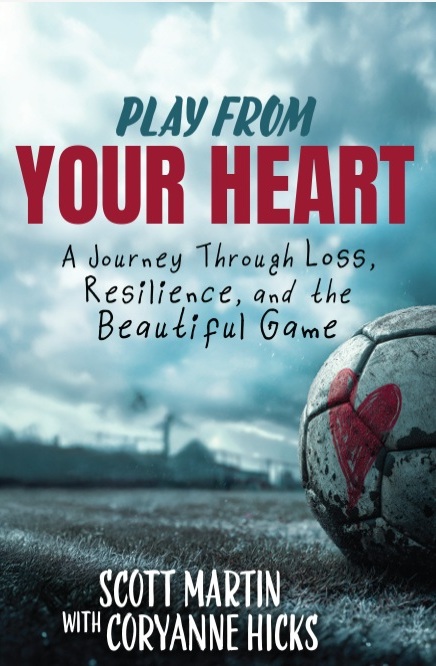
Book Details:
Author: Scott Martin and Coryanne Hicks
Release Date: 9 June 2026Series:
Genre: Soccer Biography
Format: E-book
Pages: 227 pages
Publisher: Library Tales Publishing
Blurb:
When rising college soccer coach Scott Martin was struck down by a rare, flesh-eating infection that took both hands and parts of his feet, doctors told him he was lucky just to survive. But survival wasn’t enough. Overnight, the man who lived for the game had to relearn how to move, teach, and live without the very tools that defined him.
From hospital beds and courtroom battles to the touchline of a dusty youth-league field, Martin’s twenty-year odyssey is one of heartbreak and rebirth. He rebuilt his body, lost—and found—his purpose, married the doctor who saved him, adopted five children from around the world, and, when everything seemed over again, rediscovered his passion by leading a ragtag team of twelve-year-olds to an undefeated state championship.
Told with unflinching honesty and humor, Play From Your Heart is a memoir about endurance, grace, and the power of sport to heal what medicine cannot. For anyone who’s ever faced the unthinkable, and still chosen to stand back up, this is a story that proves the human spirit is undefeated.
Fans of Wild, Crying in H Mart, and Good for a Girl will find themselves cheering, weeping, and ultimately believing again in the beautiful game, and in the resilience of the human heart.
Review
Play From Your Heart by Scott Martin and Coryanne Hicks is a memoir about survival, disability, grief, family, and soccer, but more than anything, it is a book about identity: what happens when the life you built, the body you trusted, and the future you assumed were yours are violently interrupted. The book begins with Martin at the height of his physical and professional confidence, driving toward a Nike regional soccer camp in 1993, convinced his coaching career is moving exactly where it should. Within days, that momentum collapses into a medical catastrophe: toxic shock syndrome, necrotizing fasciitis, a month-long coma, multiple organ failure, and the amputation of both hands and parts of both feet.
What makes the memoir so compelling is its refusal to make resilience look neat. Martin’s recovery is not presented as a glossy motivational arc where determination magically solves everything. Instead, the book gives us the brutal daily mechanics of rebuilding a life: learning to sit up, stand, walk, use prosthetic hooks and later myoelectric hands, feed himself, drive again, coach again, and endure the emotional fog that follows trauma. Some of the strongest sections are not the most dramatic medical moments, but the quieter ones; the frustration of eating spaghetti with hooks, the humiliation of being stared at, the panic attacks, the guilt of watching family suffer, and the slow recognition that physical disability can become an emotional one when grief is left unprocessed.
The heart of the book, however, lies in its relationships. Martin’s mother is unforgettable: fierce, unsentimental, and almost mythic in her refusal to let him surrender. His friends, teammates, medical team, and later his young soccer players all become part of the larger story of how a person is held together by community when willpower alone is not enough. I especially appreciated how the memoir keeps returning to soccer not merely as a profession, but as a language of life. The “beautiful game” becomes Martin’s way of understanding discipline, improvisation, dignity, loss, teaching, and joy. By the end, when he tells young players that they do not need expensive cleats or constant instruction, only “a ball and a wall,” the title lands with real emotional force: to play from your heart is not a slogan here; it is a philosophy earned through pain.
Overall, Play From Your Heart is a moving and candid memoir about catastrophic illness, disability, adaptation, coaching, and the stubborn work of reclaiming joy. It is painful in places, but never self-pitying; inspiring, but never simplistic. Most importantly, it understands that resilience is not the absence of grief, it is the process of learning how to live alongside it.


I love reading your comments, so please go ahead…