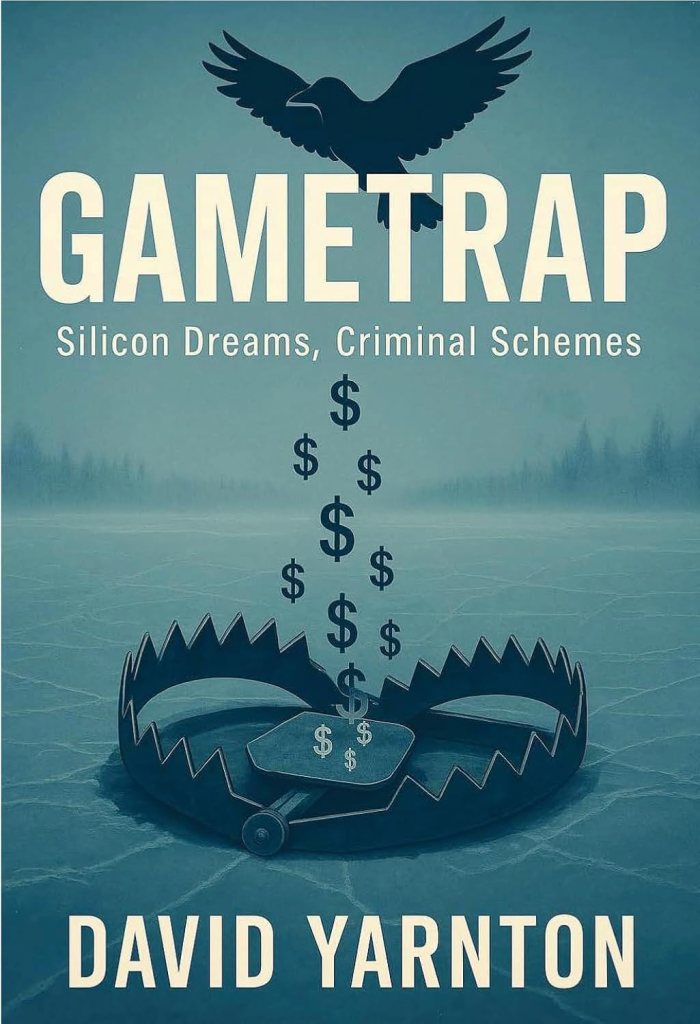
Book Details:
Author: David Yarnton
Release Date: 8 December, 2025Series:
Genre: Techno-Thriller, Financial Thriller, Boardroom/Corporate Thriller
Format: E-book
Pages: 472 pages
Publisher: 8TE, 8 Tech Express Limited
Blurb:
When Isabella Lindström is drawn into the glittering world of VANTIX™ the tech startup promising to take on Nintendo she thinks she’s backing the next big thing. But as launch parties give way to missing money, vanished allies, and whispers of criminal ties, she and her friends uncover a scheme far bigger than anyone imagined.
Set across Stockholm, London, and Los Angeles, “GameTrap” is a gripping financial thriller where ambition comes at a cost, and the truth is buried under layers of branding, buzz, and betrayal.
INSPIRED BY REAL EVENTS
Against the high-stakes backdrop of early 2000s tech ambition, “GameTrap” weaves a compelling tale of deception, ambition, and fractured loyalties loosely inspired by the real-world collapse of Gizmondo. What begins as a flashy handheld-console launch spirals into a far-reaching thriller filled with questionable finance, charismatic manipulators, and a determined trio trying to uncover the truth.
Review
GameTrap by David Yarnton is the kind of thriller that thrives not on bullets or body counts alone, but on performance—on image, seduction, money, access, and the soft glamour of rooms where everybody is pretending not to calculate everybody else. Framed against the feverish optimism of the early-2000s gaming boom and loosely inspired by the real-world collapse of Gizmondo, the book enters its world with style: handheld-console ambition, startup mythology, champagne-fuelled persuasion, and the dangerous ease with which hype can be mistaken for innovation. From the outset, author Yarnton makes it clear that VANTIX is not merely a tech dream but a warning system disguised as one.
I especially liked the novel’s atmosphere of cultivated unreality. The early Uppsala and Stockholm sequences are lush with intrigue, but also just slightly overlit, as though the reader is being invited to admire the chandeliers while something darker moves beneath the floorboards. The introduction of Isabella Lindström and Isolde is written with almost operatic confidence: they arrive as forces, women whose glamour is inseparable from their danger. That heightened, almost cinematic energy becomes the book’s signature mode. Author Yarnton clearly understands the allure of surfaces, of beautiful hotels, expensive wine, private dinners, and coded invitations, and more importantly, he understands how those surfaces can be weaponised. In that sense, GameTrap is as much about theatre as it is about finance.
The novel’s core conceit, a gaming platform and handheld device that doubles as a behavioural surveillance engine, gives the book its most interesting thematic edge. What begins as startup seduction gradually reveals itself as something far more invasive: a system designed not just to entertain, but to profile, predict, and monetise human behaviour. Author Yarnton is at his strongest when he leans into that idea. The line between game, trap, and financial instrument grows increasingly blurred, and the novel is most compelling when it exposes how naturally those worlds bleed into each other.
The character dynamics, too, carry a real current of interest. Isabella is arguably the novel’s most compelling creation: poised, intelligent, and always slightly unreadable, she moves through the narrative with the kind of controlled opacity that suits this world. Her relationship to power gives the book one of its stronger psychological undercurrents. Isolde, by contrast, brings volatility, instinct, and a more emotionally exposed energy, particularly once the novel begins threading in questions of inheritance, criminal legacy, and the revelation that her family history may be tied to the same underworld that shaped Stieg’s ascent. Erik’s thread, with Jonas’s disappearance and the gradually resurfacing truth, adds a more grounded emotional stake that helps counterbalance the novel’s glossy surfaces. There is a genuine attempt here to make the thriller machinery personal.
What I admired most, however, is the book’s ambition. Author Yarnton is not content to write a narrow corporate thriller; he wants glamour, crime, surveillance, old money, nightlife, academic memory, organised violence, tech-world delusion, and transnational fraud all in the same ecosystem. At times, that maximalism works very well. The novel has momentum, and it knows how to build a chapter ending that makes you keep turning the pages. Its world is populated by stylish operators, dubious financiers, vanished friends, and men who reinvent criminality as entrepreneurship. The prose often leans deliberately cinematic, and in the right scenes that heightened quality gives the story exactly the sort of sleek, high-stakes pulse it wants.
That said, GameTrap is also a novel whose reach occasionally exceeds its grip. There are stretches where exposition arrives in dense waves, and where the sheer amount of backstory, intrigue, and revelation competes with emotional texture rather than deepening it. The book sometimes tells us a little more than it needs to, especially in scenes where atmosphere or implication might have served the suspense more elegantly. Likewise, because the story moves through so many tones such as seductive thriller, noir mystery, tech-conspiracy drama, and criminal legacy saga, it can at times feel slightly overextended, as though several different novels are trying to coexist under one stylish roof. Some readers will enjoy that abundance; others may wish for a firmer editorial hand, particularly where pacing and repetition are concerned.
Still, even where it sprawls, GameTrap remains interesting. It is never dull, and it is rarely without intent. Beneath its polished surfaces lies a recognisable contemporary anxiety: that in an age of branding, venture capital, and behavioural data, the most dangerous scams are the ones that arrive looking like innovation. Author Yarnton understands that well. He understands, too, that people are often seduced less by lies than by the version of themselves those lies permit them to become.













 The Reading Bud