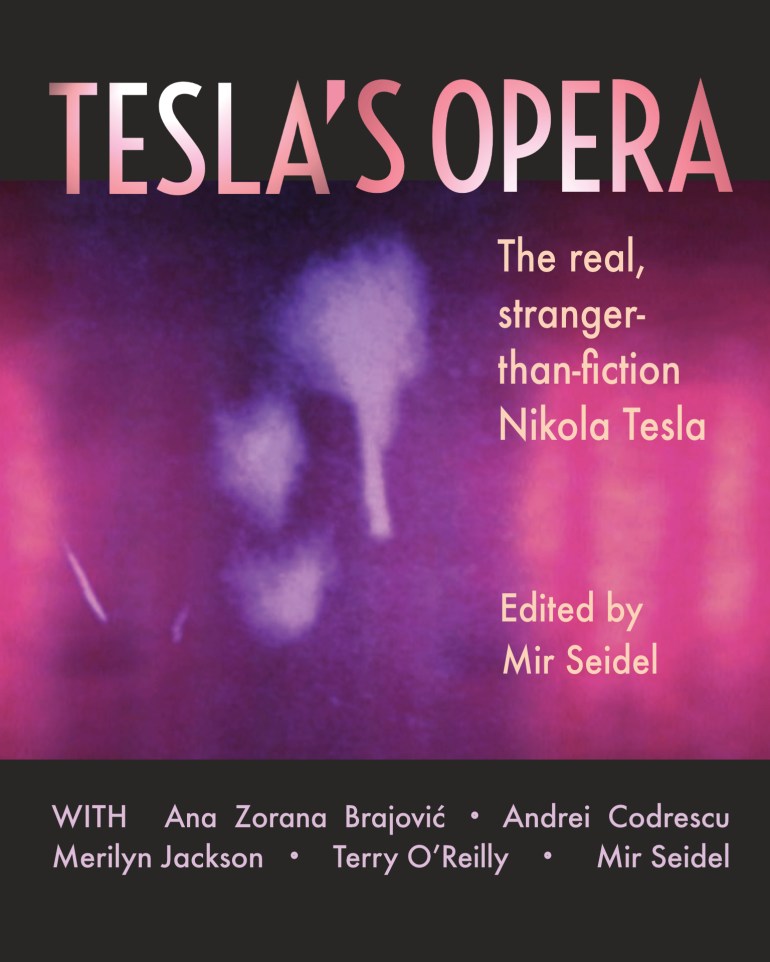
Book Details:
Author: Mir Seidel
Release Date: 02 September, 2025Series:
Genre: Non-fiction, Crossovers Opera & Biography
Format: E-book
Pages: 126 pages
Publisher: –
Blurb:
Tesla’s Opera: The Real, Stranger-Than-Fiction Nikola Tesla brings the visionary inventor Nikola Tesla to life through the opera he inspired, Violet Fire. For its creators, only opera could encompass the extremes and surreal qualities of Tesla’s life and career: the visions he had from childhood, his inventions that helped create our wired and wireless world, even his unrealized ideas. Tesla moved in the heights of New York society, yet he never married, and gave his love to a white pigeon.
With a score by minimalist composer Jon Gibson, libretto by Mir Seidel, and directed by Terry O’Reilly, Violet Fire had its world premiere in Serbia, Tesla’s homeland, on the 150th anniversary of his birth. Tesla’s Opera includes the full libretto, stunning photos from the performance, and haunting images from the continuous video projections, along with commentary by the opera’s librettist, director, and conductor, critic Merilyn Jackson, and author/poet Andrei Codrescu.
This book offers us the Tesla we need now-stranger than fiction, worthy of remembrance, and packed with meaning for our time.
Review
Tesla’s Opera: The Real, Stranger-than-Fiction Nikola Tesla by Mir Seidel, is a hybrid work: part artistic archive, part cultural reclamation, part libretto, part visual-performance document, and part meditation on Tesla as scientist, mystic, showman, futurist, and mythic figure. The result is a slim but densely layered volume that asks us to look past the overused name “Tesla” and return to the actual man behind it.
The book’s strongest sections are those in which author Seidel reflects on why Tesla’s life demanded operatic treatment. Her framing is compelling: Tesla was not merely an inventor of alternating current, radio-adjacent technologies, robotics, and wireless possibility; he was also a man of visions, contradictions, loneliness, and strange tenderness, most famously embodied in his bond with the white pigeon he loved. That image becomes the emotional and spiritual centre of Violet Fire, allowing the opera to explore not only Tesla’s achievements but his isolation, his yearning, and the mystery of a mind that seemed always half in the laboratory and half in some higher electrical dream-state.
What makes the book especially engaging is its plurality of voices. Andrei Codrescu’s opening poem is sharp, irreverent, and intentionally provocative; Seidel’s essays are lucid and thoughtful; Terry O’Reilly’s account of directing the opera brings theatrical intelligence and warmth; Merilyn Jackson’s dance-critical perspective gives the White Dove and choreography their due; and Ana Zorana Brajović’s brief reflection adds a deeply felt Serbian connection to Tesla as cultural hero. Together, these pieces create a living record of an ambitious multimedia opera that moved through Philadelphia, Belgrade, and New York, shaped by music, projection, dance, history, and myth.
Visually, the book is also rewarding. The performance photographs, projection stills, score excerpts, and historical images give the reader a sense of Violet Fire as something larger than text: a stage-world of light, bodies, machinery, pigeons, towers, sparks, and shadow. The libretto itself is poetic and fragmentary in the best sense.
That said, this might not be for readers looking for a straightforward Tesla biography. It assumes some openness to experimental form, opera, performance history, and artistic reflection. At times, the structure can feel more archival than fluid, especially when moving between essays, production notes, libretto pages, and appendices. But this is also part of its purpose: the book preserves the many layers of a performance work while arguing for Tesla’s continued cultural relevance.
Overall, Tesla’s Opera is a rich, unconventional, and intellectually alive tribute to Nikola Tesla and the opera he inspired. It is best read as an artistic companion, cultural essay, and poetic act of reclamation rather than a traditional biography.


I love reading your comments, so please go ahead…