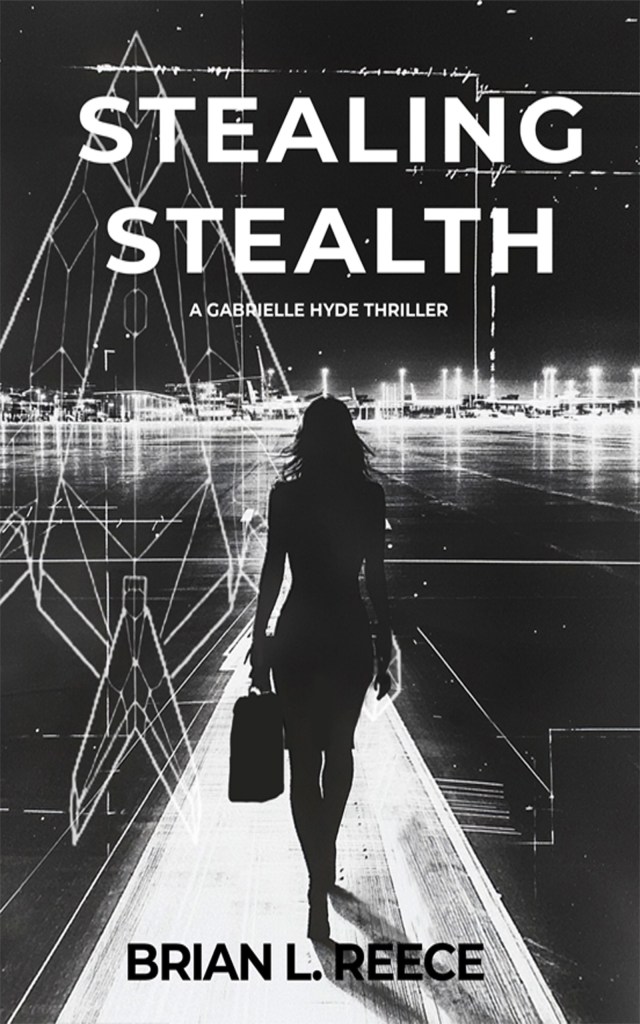
Book Details:
Author: by Brian L. Reece
Release Date: 13 January, 2026
Series: A Gabrielle Hyde Thriller
Genre: Cold War Techno-Thriller
Format: E-book
Pages: 472 pages
Publisher: Waffle Ink Press
Blurb:
The only way to protect the ultimate secret is to steal it.
1977. Deep inside the secretive Skunk Works facility, the United States is forging its biggest advantage of the Cold War: Stealth technology. Invisible to radar, it will shift the global balance of power forever. But a traitor at the highest level is about to hand the blueprints to the Soviets.
CIA Officer John Olson has seven days to stop the leak. But his agency is compromised, the FBI is hunting him, and the official protocols are a suicide pact. Out of time and out of options, Olson realizes he can’t save the program by following the rules. He has to break them.
Olson turns to the only person capable of stealing the unstealable: Gabrielle Hyde. The brilliant, elusive con artist he spent a decade hunting is now his only hope.
Together, they must launch an elaborate con against the U.S. government itself. From the dusty streets of Africa to the high-security vaults of Los Angeles, they must outwit a ruthless KGB assassin and a vengeful FBI agent to pull off the greatest heist in military history.
Review
Stealing Stealth by Brian L. Reece is a cold war techno thriller that aims to build an entire machinery of tension around intelligence, ideology, and people’s weakness. Framed around the race to protect an experimental U.S. stealth program from Soviet acquisition, the novel operates on two levels at once: as a brisk Cold War espionage thriller, and as a character-driven study of ambition, loyalty, grief, and moral compromise. From its opening pages in 1975 Toronto, where master thief Gabrielle Hyde stages an audacious burglary and first collides with rising CIA officer John Olson, the book makes clear that it is as interested in psychology as it is in action.
What gives the novel much of its energy and flair is this central pairing. Gabrielle is not written as a stock femme-fatale criminal; she is elegant, manipulative, deeply intelligent, and consistently operating several moves ahead of everyone around her. John, by contrast, begins as a man of structure, duty, and institutional faith, yet the novel repeatedly places him in situations where those systems fail him, exploit him, or demand moral elasticity in return for survival. Their first major encounter, ending in Hyde’s escape and Olson’s humiliation, sets the emotional temperature of the book, but author Reece smartly refuses to leave their dynamic in simple opposition. Over time, the relationship develops into a battle of methods, then of values, and eventually a wary, unstable interdependence.
The book’s strongest thematic thread is its preoccupation with systems such as government systems, intelligence systems, bureaucratic systems, and the ways all of them reward expediency over truth. By the time the plot widens into the stealth-theft conspiracy, the novel is no longer merely asking whether the Soviets will obtain classified technology; it is asking who within the American apparatus is willing to betray principle, how far “patriotism” can be manipulated, and whether institutional loyalty is ever morally clean. The discovery that the stolen material concerns the Have-Blue, a stealth fighter program, and the fear that Soviet access to it could destabilize nuclear balance, raises the stakes effectively without reducing the story to dry technothriller exposition.
I also appreciated that the author gives the novel emotional ballast through loss and aftermath. Olson’s partnership with Nate Balik and the tragedy that follows in Mogadishu sharpen the book considerably, because from that point onward the story is no longer simply about stopping adversaries; it becomes about what failure costs, and what kind of man John is becoming in response to that cost. By the final stretch, the novel’s question is not just whether Hyde can be caught or trusted, but whether John can emerge from this world with any coherent sense of self still intact. The closing chapters land this surprisingly well: Hyde remains elusive and morally uncategorizable, while John, having survived the machinery of espionage and compromise, moves toward a humbler but more self-directed future. The final pages, with John reclaiming choice in ordinary life while Hyde vanishes once again on her own terms, give the book a satisfying emotional aftertaste without sanding away its ambiguity.
If I were to pick a minor flaw (which I can’t help being an editor), it is that the novel’s sheer velocity and density can occasionally work against it. There are stretches where plot mechanics, operational briefings, and layered maneuvering arrive so quickly that the emotional transitions have to fight for air. Readers who prefer leaner spy fiction may at times feel the book is carrying several thriller modes at once such as classic espionage, political conspiracy, procedural pursuit, and caper energy. But to be fair, that maximalism is also part of its identity as author Reece is not writing a minimalist chamber thriller, he is writing a large, unapologetically cinematic Cold War story with moving parts, ideological stakes, and characters who are always one betrayal away from collapse.
Overall, Stealing Stealth succeeds because it understands that espionage is never only about secrets, it is about the people deformed, seduced, or sharpened by proximity to those secrets. Smart, ambitious, and highly readable, it offers enough action for thriller readers while giving its central relationship a complexity that elevates it above mere cat-and-mouse entertainment. It is, in the best sense, a novel about pursuit… of technology, of truth, of redemption, and of the one person clever enough to keep turning all of those pursuits inside out.

 The Reading Bud