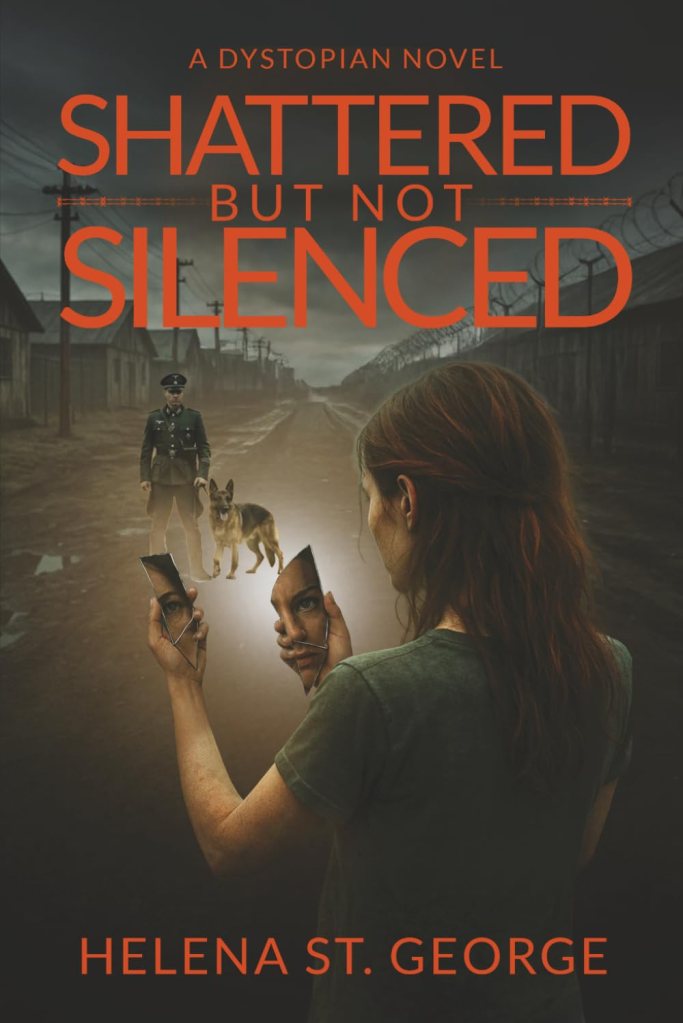
Book Details:
Author: Helena St. George
Release Date: 15 March, 2025Series:
Genre: Dystopian, Speculative Fiction, Psychological, Social Commentary
Format: E-book
Pages: 431 pages
Publisher: Helena St. George
Blurb:
In a world where productivity is the measure of one’s worth, who decides human value?
Set in a near-future America devastated by economic collapse, Shattered But Not Silenced imagines a regime that targets social service recipients, the disabled, the mentally ill, and the homeless for “reform” under the guise of economic recovery.
At the center is Maya, an autistic young woman navigating a country in turmoil while surviving forced rehabilitation inside the New Thought Center. Her sensory sensitivities, coping mechanisms, and layered internal processing are revealed through her sharp, ironic first-person voice. She is complex. She is observant. She is defiant.
The novel asks difficult questions. Who defines human value? What happens to those who do not meet the definition?
ARC Reader Review: “I liked Maya the more I got to know her. The writing is amazing! So many well-crafted sentences and paragraphs. The language used to describe the settings and in dialogue flows. Now that the novel has ended, I’ll miss Maya. Great job tying up loose ends. Well done!”
ARC Reader Review: “Great writing… You had me at the first page wanting more. Four chapters in and I can’t wait to read the next one! Honestly!!! I can’t put this book down. Maya got arrested! Wow! Didn’t expect that!”
ARC Reader Review: “You know it’s a good read if it makes you cry.”
Review
Shattered but Not Silenced by Helena St. George offers a very unsettling yet profound narrative that examines control, autonomy, and the fragile line between protection and oppression. At its core is Maya, a neurodivergent protagonist wading through a society that increasingly defines human worth through productivity, compliance, and conformity, a premise that feels less like fiction and more like an uncomfortable extension of reality.
What struck me most about this novel is not its dystopian machinery, but its interiority. This is not a plot-driven rebellion story in the conventional sense. Instead, it is a slow, deliberate descent into systems of control, especially economic, institutional, and psychological. The narrative begins almost deceptively grounded, but as the story progresses, the cracks widen, revealing a society tightening its grip through surveillance, propaganda, and systemic erasure.
Maya’s perspective is the novel’s greatest strength. Her sensory processing, looping thoughts, and emotional responses are not treated as narrative devices but as intrinsic ways of being. Author Helena handles this with notable care and authenticity, ensuring that Maya’s neurodivergence is neither romanticized nor reductive. This lends the narrative a rare intimacy where the reader is not simply observing oppression, but feeling its texture through Maya’s experience.
Thematically, the novel is relentless. It interrogates systems that claim to rehabilitate but are built to control. The progression from societal unrest to forced confinement and indoctrination is chilling precisely because it feels incremental. Structurally, the book is expansive. With a timeline that spans over a year and a half, the narrative charts Maya’s transition from a struggling young adult to someone entangled within a system that seeks to redefine her very identity. This progression allows the author to build tension gradually, though, in my opinion, at times it also leads to a sense of narrative diffusion leading to certain stretches that could have benefited from tighter pacing and sharper scene consolidation.
Where the novel wins is in its refusal to offer easy catharsis. The ending, and especially the afterword, makes it clear that this is not a story of triumphant resilience in the conventional sense. Survival here is not heroic; it is uneven and personal. This is a bold narrative choice and that may unsettle readers expecting a more traditional arc, but it ultimately reinforces the book’s thematic integrity. That said, the novel is not without its limitations. The density of its themes occasionally overtakes narrative momentum, and some external characters feel less fully realized compared to Maya’s richly developed interior world. Additionally, readers seeking a faster-paced, plot-heavy dystopian thriller may find the introspective tone demanding.
But perhaps that is precisely the point as Shattered but Not Silenced does not try to entertain in the conventional sense, it simply tries to bear witness. It asks difficult questions about who gets to define value, who is deemed “fit” for society, and what happens to those who exist outside those definitions. And more importantly, it refuses to look away from the answers.
 The Reading Bud