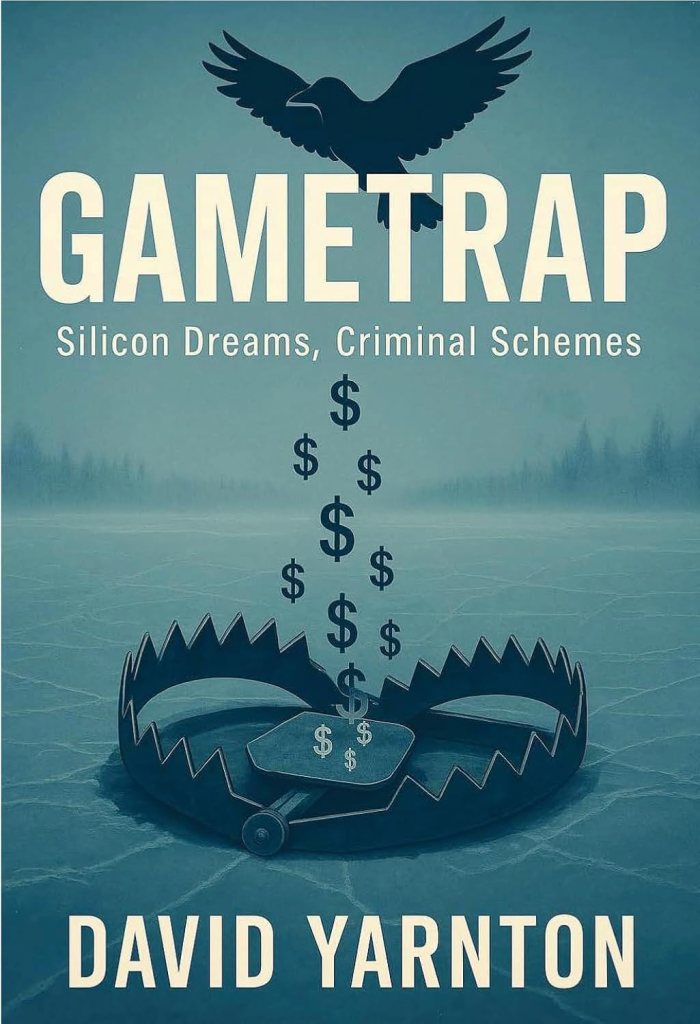
Book Review: GameTrap: Silicon Dreams, Criminal Schemes by David Yarnton

Book Details:

Author: David Yarnton
Release Date: 8 December, 2025
Series:
Genre: Techno-Thriller, Financial Thriller, Boardroom/Corporate Thriller
Format:ย E-bookย 
Pages: 472 pages
Publisher: 8TE,ย 8 Tech Express Limited
Blurb:
When Isabella Lindstrรถm is drawn into the glittering world of VANTIXโ„ข the tech startup promising to take on Nintendo she thinks sheโ€™s backing the next big thing. But as launch parties give way to missing money, vanished allies, and whispers of criminal ties, she and her friends uncover a scheme far bigger than anyone imagined.
Set across Stockholm, London, and Los Angeles, โ€œGameTrapโ€ is a gripping financial thriller where ambition comes at a cost, and the truth is buried under layers of branding, buzz, and betrayal.
INSPIRED BY REAL EVENTS
Against the high-stakes backdrop of early 2000s tech ambition, โ€œGameTrapโ€ weaves a compelling tale of deception, ambition, and fractured loyalties loosely inspired by the real-world collapse of Gizmondo. What begins as a flashy handheld-console launch spirals into a far-reaching thriller filled with questionable finance, charismatic manipulators, and a determined trio trying to uncover the truth.

Review

Rating: 4.5 out of 5.

GameTrap by David Yarnton is the kind of thriller that thrives not on bullets or body counts alone, but on performanceโ€”on image, seduction, money, access, and the soft glamour of rooms where everybody is pretending not to calculate everybody else. Framed against the feverish optimism of the early-2000s gaming boom and loosely inspired by the real-world collapse of Gizmondo, the book enters its world with style: handheld-console ambition, startup mythology, champagne-fuelled persuasion, and the dangerous ease with which hype can be mistaken for innovation. From the outset, author Yarnton makes it clear that VANTIX is not merely a tech dream but a warning system disguised as one.

I especially liked the novel’s atmosphere of cultivated unreality. The early Uppsala and Stockholm sequences are lush with intrigue, but also just slightly overlit, as though the reader is being invited to admire the chandeliers while something darker moves beneath the floorboards. The introduction of Isabella Lindstrรถm and Isolde is written with almost operatic confidence: they arrive as forces, women whose glamour is inseparable from their danger. That heightened, almost cinematic energy becomes the bookโ€™s signature mode. Author Yarnton clearly understands the allure of surfaces, of beautiful hotels, expensive wine, private dinners, and coded invitations, and more importantly, he understands how those surfaces can be weaponised. In that sense, GameTrap is as much about theatre as it is about finance.

The novelโ€™s core conceit, a gaming platform and handheld device that doubles as a behavioural surveillance engine, gives the book its most interesting thematic edge. What begins as startup seduction gradually reveals itself as something far more invasive: a system designed not just to entertain, but to profile, predict, and monetise human behaviour. Author Yarnton is at his strongest when he leans into that idea. The line between game, trap, and financial instrument grows increasingly blurred, and the novel is most compelling when it exposes how naturally those worlds bleed into each other.

The character dynamics, too, carry a real current of interest. Isabella is arguably the novelโ€™s most compelling creation: poised, intelligent, and always slightly unreadable, she moves through the narrative with the kind of controlled opacity that suits this world. Her relationship to power gives the book one of its stronger psychological undercurrents. Isolde, by contrast, brings volatility, instinct, and a more emotionally exposed energy, particularly once the novel begins threading in questions of inheritance, criminal legacy, and the revelation that her family history may be tied to the same underworld that shaped Stiegโ€™s ascent. Erikโ€™s thread, with Jonasโ€™s disappearance and the gradually resurfacing truth, adds a more grounded emotional stake that helps counterbalance the novelโ€™s glossy surfaces. There is a genuine attempt here to make the thriller machinery personal.

What I admired most, however, is the bookโ€™s ambition. Author Yarnton is not content to write a narrow corporate thriller; he wants glamour, crime, surveillance, old money, nightlife, academic memory, organised violence, tech-world delusion, and transnational fraud all in the same ecosystem. At times, that maximalism works very well. The novel has momentum, and it knows how to build a chapter ending that makes you keep turning the pages. Its world is populated by stylish operators, dubious financiers, vanished friends, and men who reinvent criminality as entrepreneurship. The prose often leans deliberately cinematic, and in the right scenes that heightened quality gives the story exactly the sort of sleek, high-stakes pulse it wants.

That said, GameTrap is also a novel whose reach occasionally exceeds its grip. There are stretches where exposition arrives in dense waves, and where the sheer amount of backstory, intrigue, and revelation competes with emotional texture rather than deepening it. The book sometimes tells us a little more than it needs to, especially in scenes where atmosphere or implication might have served the suspense more elegantly. Likewise, because the story moves through so many tones such as seductive thriller, noir mystery, tech-conspiracy drama, and criminal legacy saga, it can at times feel slightly overextended, as though several different novels are trying to coexist under one stylish roof. Some readers will enjoy that abundance; others may wish for a firmer editorial hand, particularly where pacing and repetition are concerned.

Still, even where it sprawls, GameTrap remains interesting. It is never dull, and it is rarely without intent. Beneath its polished surfaces lies a recognisable contemporary anxiety: that in an age of branding, venture capital, and behavioural data, the most dangerous scams are the ones that arrive looking like innovation. Author Yarnton understands that well. He understands, too, that people are often seduced less by lies than by the version of themselves those lies permit them to become.

You can also read this review at:

Goodreads


Amazon


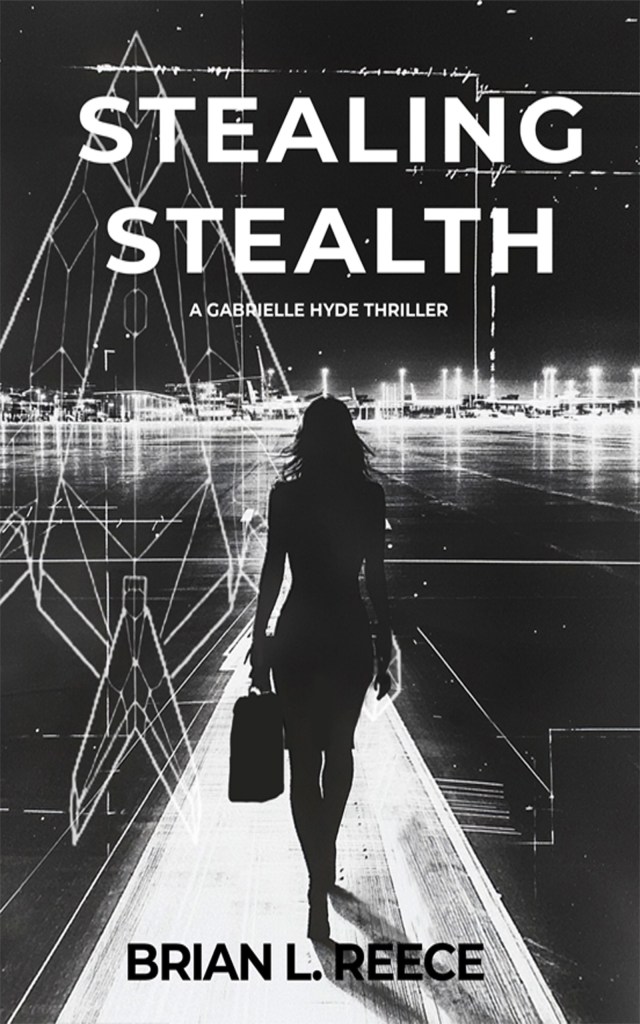
Book Review: Stealing Stealth: A Gabrielle Hyde Thriller byย Brian L. Reece

Book Details:

Author: by Brian L. Reece 
Release Date: 13 January, 2026
Series: A Gabrielle Hyde Thriller
Genre: Cold War Techno-Thriller
Format: E-book 
Pages: 472 pages
Publisher: Waffle Ink Press
Blurb:
The only way to protect the ultimate secret is to steal it.
1977. Deep inside the secretive Skunk Works facility, the United States is forging its biggest advantage of the Cold War: Stealth technology. Invisible to radar, it will shift the global balance of power forever. But a traitor at the highest level is about to hand the blueprints to the Soviets.
CIA Officer John Olson has seven days to stop the leak. But his agency is compromised, the FBI is hunting him, and the official protocols are a suicide pact. Out of time and out of options, Olson realizes he canโ€™t save the program by following the rules. He has to break them.
Olson turns to the only person capable of stealing the unstealable: Gabrielle Hyde. The brilliant, elusive con artist he spent a decade hunting is now his only hope.
Together, they must launch an elaborate con against the U.S. government itself. From the dusty streets of Africa to the high-security vaults of Los Angeles, they must outwit a ruthless KGB assassin and a vengeful FBI agent to pull off the greatest heist in military history.

Review

Rating: 4.5 out of 5.

Stealing Stealth by Brian L. Reece is a cold war techno thriller that aims to build an entire machinery of tension around intelligence, ideology, and people’s weakness. Framed around the race to protect an experimental U.S. stealth program from Soviet acquisition, the novel operates on two levels at once: as a brisk Cold War espionage thriller, and as a character-driven study of ambition, loyalty, grief, and moral compromise. From its opening pages in 1975 Toronto, where master thief Gabrielle Hyde stages an audacious burglary and first collides with rising CIA officer John Olson, the book makes clear that it is as interested in psychology as it is in action.

What gives the novel much of its energy and flair is this central pairing. Gabrielle is not written as a stock femme-fatale criminal; she is elegant, manipulative, deeply intelligent, and consistently operating several moves ahead of everyone around her. John, by contrast, begins as a man of structure, duty, and institutional faith, yet the novel repeatedly places him in situations where those systems fail him, exploit him, or demand moral elasticity in return for survival. Their first major encounter, ending in Hydeโ€™s escape and Olsonโ€™s humiliation, sets the emotional temperature of the book, but author Reece smartly refuses to leave their dynamic in simple opposition. Over time, the relationship develops into a battle of methods, then of values, and eventually a wary, unstable interdependence.

The bookโ€™s strongest thematic thread is its preoccupation with systems such as government systems, intelligence systems, bureaucratic systems, and the ways all of them reward expediency over truth. By the time the plot widens into the stealth-theft conspiracy, the novel is no longer merely asking whether the Soviets will obtain classified technology; it is asking who within the American apparatus is willing to betray principle, how far โ€œpatriotismโ€ can be manipulated, and whether institutional loyalty is ever morally clean. The discovery that the stolen material concerns the Have-Blue, a stealth fighter program, and the fear that Soviet access to it could destabilize nuclear balance, raises the stakes effectively without reducing the story to dry technothriller exposition.

I also appreciated that the author gives the novel emotional ballast through loss and aftermath. Olsonโ€™s partnership with Nate Balik and the tragedy that follows in Mogadishu sharpen the book considerably, because from that point onward the story is no longer simply about stopping adversaries; it becomes about what failure costs, and what kind of man John is becoming in response to that cost. By the final stretch, the novelโ€™s question is not just whether Hyde can be caught or trusted, but whether John can emerge from this world with any coherent sense of self still intact. The closing chapters land this surprisingly well: Hyde remains elusive and morally uncategorizable, while John, having survived the machinery of espionage and compromise, moves toward a humbler but more self-directed future. The final pages, with John reclaiming choice in ordinary life while Hyde vanishes once again on her own terms, give the book a satisfying emotional aftertaste without sanding away its ambiguity.

If I were to pick a minor flaw (which I can’t help being an editor), it is that the novelโ€™s sheer velocity and density can occasionally work against it. There are stretches where plot mechanics, operational briefings, and layered maneuvering arrive so quickly that the emotional transitions have to fight for air. Readers who prefer leaner spy fiction may at times feel the book is carrying several thriller modes at once such as classic espionage, political conspiracy, procedural pursuit, and caper energy. But to be fair, that maximalism is also part of its identity as author Reece is not writing a minimalist chamber thriller, he is writing a large, unapologetically cinematic Cold War story with moving parts, ideological stakes, and characters who are always one betrayal away from collapse.

Overall, Stealing Stealth succeeds because it understands that espionage is never only about secrets, it is about the people deformed, seduced, or sharpened by proximity to those secrets. Smart, ambitious, and highly readable, it offers enough action for thriller readers while giving its central relationship a complexity that elevates it above mere cat-and-mouse entertainment. It is, in the best sense, a novel about pursuit… of technology, of truth, of redemption, and of the one person clever enough to keep turning all of those pursuits inside out.


You can also read this review at:

Goodreads


Amazon


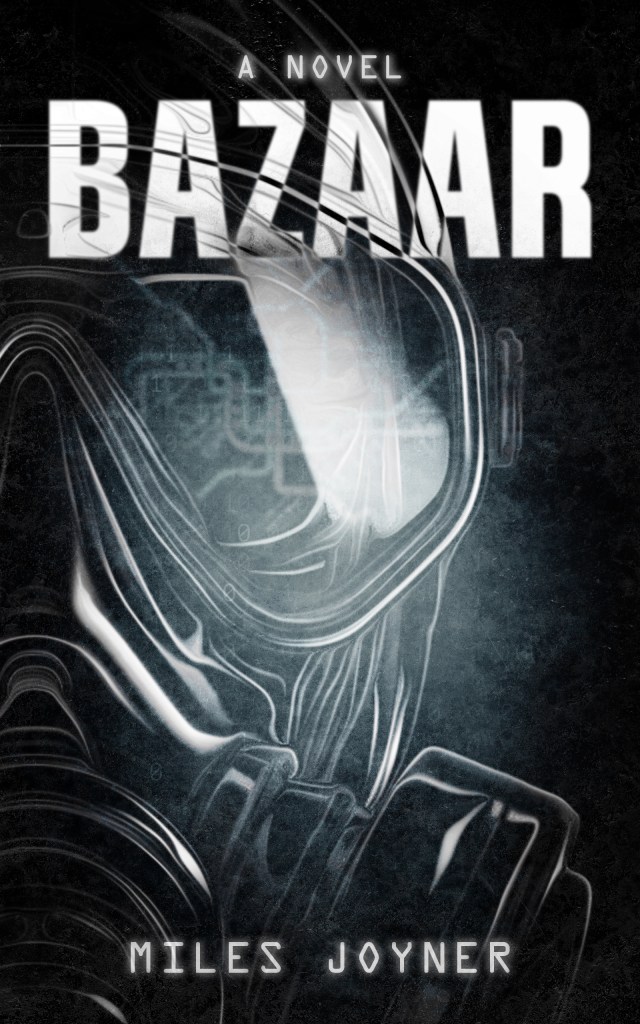
Book Review: Bazaar by Miles Joyner

Book Details:

Author: ย Miles Joyner
Release Date:
March 24, 2025
Series:
Genre: Techno-Thriller, Mystery, Thriller, Suspense
Format:ย E-bookย 
Pages: 355 pages
Publisher: World Castle Publishing, LLC
Blurb:
A high-profile homicide of a former ambassador’s son in the nightlife district of the nation’s capital gets connected to an assassination market on the dark web, turning the DC area into a battlefield over a new generation of class warfare. When the ex-diplomat, Chiedu Attah, hires an elite executive protection team headed by siblings Yemi and Karen Uzunma to guarantee his safety, the security firm realizes they are going up against a young, inventive contract killer who is determined to finish off the political VIP by any means necessary.

Review

Rating: 4.5 out of 5.

Bazaar by Miles Joyner is one of those books that grabs you by the collar from page one and refuses to let go until itโ€™s dragged youโ€”wide-eyed and slightly breathlessโ€”through a world where dark web markets, untraceable firearms, and calculated assassinations are the currency of the day. It’s part dystopian cyber-thriller, part political commentary, and entirely relevant in a way that feels almost uncomfortably prescient.

As a writer and editor, what stood out to me immediately was author Joynerโ€™s voice: gritty, propulsive, and unapologetically bold. He doesnโ€™t shy away from tackling difficult themes such as urban decay, institutional failure, the banality of violence, and yet manages to keep his narrative character-driven and emotionally sharp.

The protagonist, Aaron, is a complex, morally gray young man whose descent into digital-era vigilantism is disturbingly relatable. And the marketplace known as Bazaar, where people bid on assassination dates? Terrifyingly inventive. The novel pulses with a kind of anxious energy that reminded me of early Bret Easton Ellis fused with the social consciousness of The Wire.

Is it perfect? Not always. The pace sometimes races ahead of character development, and a few side plots felt a bit rushedโ€”but honestly, I didn’t mind. The urgency and ambition of the book far outweigh these minor hiccups.

If you’re someone who appreciates fiction that stares unflinchingly into the chaos of modern society and emerges with something urgent to say, Bazaar deserves a spot on your shelf.


You can also read this review at:

Goodreads


Amazon