Welcome to TRB Lounge. Today, I’d like to welcome Travis Peterson, author of Salvation Reigned, for an author interview with The Reading Bud.
About The Author

Travis Peterson
Travis James Peterson is a former Marine. He has spent much of his life analyzing the world through geospatial data. Reading patterns. Looking for truth in the noise by shaping chaos into something meaningful.
The story came the way most truths do. Slowly, like water undercutting a riverbank. Then all at once. Like a mass waste event dumping earth into a violent flow. For years it lived in fragments. Flashes of light, neon flames crawling across a dark sky. Images without a frame. It wasn’t until sleep was contingent on writing a few good words that the story started taking shape. Then dreamscapes fueled his race with the morning sun to capture a story that flashed behind closed eyes.
Travis writes dark, philosophical science fiction. Short, punchy, and unafraid of hard questions.
You can find author Peterson here:
Amazon
Interview
Welcome to TRB! Please give our readers a brief introduction about yourself before we begin. (We’d love to know beyond what your Author Bio says about you.)
I am a first-generation high school and college graduate, a former Marine, and I’ve spent much of my professional life working as a geographic information systems analyst. At my core, I’m deeply curious about the world. My career has focused on asking questions and solving problems through spatial analysis, which has shaped how I see everything around me. I tend to view life as a collection of interconnected systems, and I’m endlessly fascinated by the relationships between them. What intrigues me most is how a single small decision can lead to drastic and often unexpected consequences. The world is complex. Connections go unseen.
Beyond the official blurb, could you offer us a unique insight or a behind-the-scenes glimpse into your book?
This book came out of a need to clear my mind. A few years after I began meditating and journaling as an almost daily practice, I noticed that the routine helped soothe the physical tension I carried from everyday stress. Over time, coherent images began to form, and my journaling grew richer, less about my day or my aspirations, and more about interpretation. In many ways, the book is a reflection of the systems I see, filtered through a science fiction lens.
Every book has a starting point. What was the spark or pivotal moment that inspired you to write this one?
The spark for this book came from a feeling that I finally had something to say about the world. Through meditation and journaling, moments of stillness began to surface images and ideas that would not let go. My journaling shifted from daily reflection to capturing fragments of meaning and imagined worlds. Eventually, I realized I should write the book I wanted to read, without worrying about molds or expectations. Once I started, it felt like giving life to something that had been waiting to exist.
Is there a core message or theme in your book that you wish readers to discover?
The core message of the book ultimately became about systems, though that was never my original intention. It emerged naturally as the story unfolded. Systems fascinate me because they seem to take on a life of their own. Inputs move through processes and internal machinery, and the outcomes can be surprising and unpredictable. That is what happened with this book. The story developed like a system revealing itself through fiction, shaped by its own internal logic rather than a predetermined message.
Of all the characters in your book, do you have a personal favourite? What makes them special to you?
DDL1V35 emerged as my favorite character. The cybernaut began as a machine, but over the course of the story evolved into a thinking and feeling form of life that was more than circuits and polymer. It eventually became organic matter integrated with technology, and that transformation is what ultimately survived to tell the story. It turned into a witness and philosopher. That surprised me so much!
How do you approach character development, ensuring they resonate with readers and feel authentic?
I approach character development through mimicry and patterning, drawing inspiration from people I know, people I do not know, and imagined conversations. Many of the characters in the story represent different aspects of my own personality. I try to capture how people I have known move through the world, as well as how I experience the world around me, and translate that into fiction in a way that feels honest and recognizable.
What was the inspiration for this book? Was it an idea, an anecdote, a dream, or something else?
The story grew out of a sketch. Over time, I refined that initial image, and it eventually became the book cover. I found myself wondering what words could fit the brutalist image. The narrative was also heavily influenced by my journaling practice, where I pulled recurring themes from daily meditation and reflection. As the story developed, it became a warped reflection of how I experience and interpret the world around me.
How long did it take you to write this particular book?
I spent roughly a year working on this book. I originally envisioned it as a novel, but as this was my first book, I struggled to sustain the story at that length. At times, it felt like I was writing to meet a quota rather than telling the story itself. Eventually, I decided to let the story develop on its own terms and allow the length to be what the narrative demanded.
Are you working on any other stories presently?
I am writing every day. Even if it is only one line. I have this vision of a follow-up to Salvation Reigned. Not a part two. More like a collection. The way that I wrote – in such a fast fractured method – left a lot of areas to explore. I would like to shine a light on the dark corners of the universe I created.
Why have you chosen this genre? Or do you write in multiple genres?
I am such a fan of science fiction dystopian type books. It was just felt natural to try to express myself that way too. I really like reading philosophy and hard-science literature and that made it into my style too.
When did you decide to become a writer? Was it easy for you to follow your passion, or did you have to make some sacrifices along the way? (Feel free to share your story; we love hearing author stories!)
I decided to become a writer when I realized I finally had something to say that felt uniquely my own. That realization came gradually through meditation, journaling, and a willingness to look more honestly at my life. I have always noticed patterns, especially how small decisions can lead to unintended consequences and how accountability shapes who we become. For much of my life, writing was not an option I imagined for myself. Survival, fitting in, and conformity took precedence. Eventually, I reached a point where I felt the need to express who I was, rather than who I thought I was supposed to be. Writing became the way to do that.
What is your writing ritual? How do you do it?
“Ritual” is a funny way to describe my process, because writing this book became an act of discipline more than routine. I work a full-time job and have a full life with family, so making space for the book required consistency and deliberate choices. I used whatever time I had. Early mornings, late evenings, weekends. On airplanes, buses, and as a passenger in a car. Over time, the discipline deepened into something more like obsession. Writing, editing, and drawing began to fill every available space in my day. At times it felt like I was racing fate. Like, what if something happened to me, and I didn’t finish the story? Writing this story eventually became the reason I got up in the morning. I am looking forward to getting back to some hobbies I abandoned.
Editing can be a gruelling process. How do you approach revisions and self-editing?
Editing this book was uncomfortable, but necessary. I originally wrote about 29,000 words before realizing I was not writing a novel, but something much shorter. From there, I began cutting aggressively. I removed anything that slowed the story down, explained too much, or distracted from the core movement of the narrative. If a passage did not move the action forward, reflect emotion, or earn its place on the page, it was cut. At times, it felt brutal. This was also the first book I had ever edited, and I lost count of the number of revisions. I kept revising until I felt I was trying to be too clever, and that became my signal to stop. Throughout the process, I tried to trust my first instincts, especially when it came to word choice.
With the rise of audiobooks and multimedia experiences, have you considered exploring these avenues for your stories?
I think the book is very visual and has a strong narrative voice, which naturally lends itself to audio. I have considered that it could work well as an audiobook. While I do not have any concrete plans to explore that format yet, it is something I remain open to in the future.
Lastly, if you were to describe your writing style in three words, what would they be?
Fast. Deliberate. Ruthless.
How do you prefer to write—computer/laptop, typewriter, dictation, or longhand with a pen?
I tend to write more creatively when I am using a pen and paper.
What are your 5 favourite books? (You can share 5 favourite authors too.)
- Steven King
- Chuck Palahniuk
- Kurt Vonnegut, Jr.
- Edgar Allan Poe
- Hugh Howey
How do you deal with Writer’s Block?
I took walks, exercised, read, and listened to podcasts – paranormal, science, the strange.
What advice would you give to aspiring writers?
If you want to write something then do it. If you get stuck then write one word at a time. Let the story evolve. Don’t control it.
Thank you, author Peterson, for taking the time to answer our questions and for all your brilliant and insightful answers!
About the Book
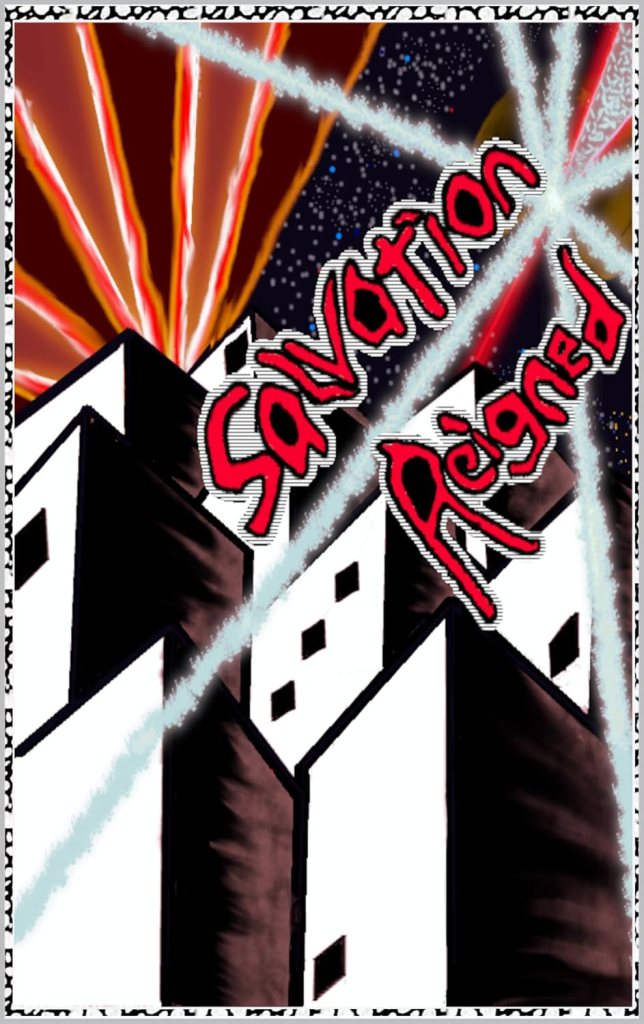
Salvation Reigned
A rogue planet is coming. Humanity’s last city has a plan. You won’t like it.
Pete wakes in POD 217 with blood on his face and no memory of yesterday. The Last Great City is clean, pleasurable, and perfectly controlled — as long as its citizens follow the cycle. Reset. Comply. Repeat.
Pete keeps failing the reset.
Somewhere in the city, a woman named Marla is looking for him. Somewhere in the past, two scientists just watched something enormous pass in front of Betelgeuse. And somewhere at the edge of a dying wasteland, a cybernaut older than civilization is sitting under a cherry tree, watching the feral descendants of humanity dance under a dying star.
Salvation Reigned moves across fractured time and colliding perspectives — the scientists who saw it coming, the city that chose control over truth, the lovers whose bond survives every attempt to erase it, and the machine left behind to witness what persists when everything else is gone.
Raw. Nonlinear. Uncompromising.
This is not a story about heroes. It is a story about what love, memory, and consciousness do when a system tries to delete them.
Adult content: extreme language and graphic violence.
For fans of Philip K. Dick, Chuck Palahniuk, and Jeff VanderMeer.
You can find Salvation Reigned here:
Amazon | Goodreads
If you are an author and wish to be featured as our guest or if you are a publicist and want to get your author featured on TRB, then please get in touch directly by e-mail at thereadingbud@gmail.com


I love reading your comments, so please go ahead…