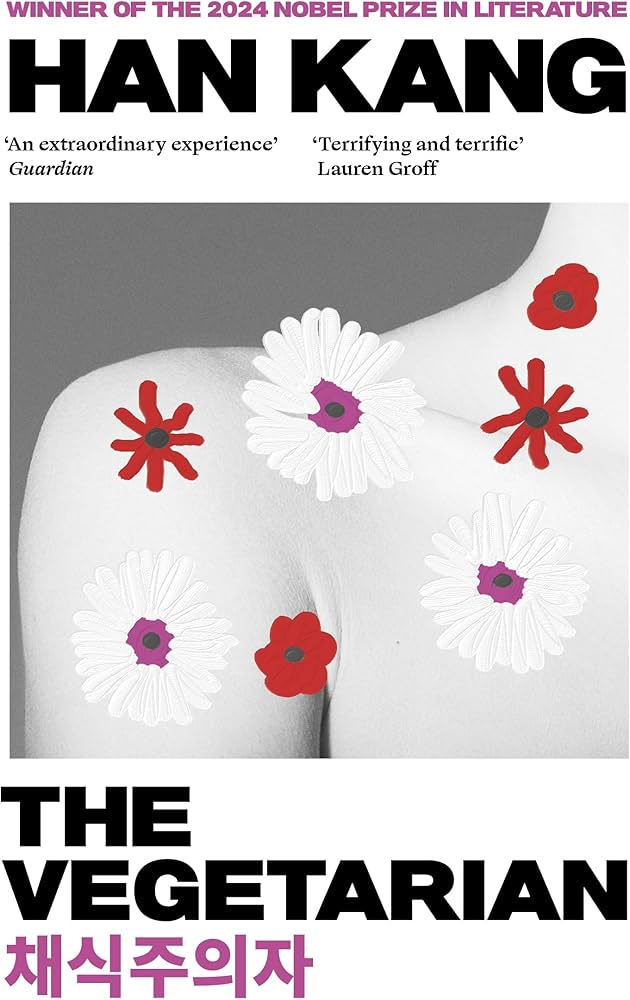
Book Details:
Author: Han Kang
Release Date: 5th November 2015Series:
Genre: Contemporary Fiction, Horror, Philosophical
Format: E-book
Pages: 192 pages
Publisher: Portobello Books
Blurb:
WINNER OF THE 2024 NOBEL PRIZE IN LITERATURE WINNER OF THE INTERNATIONAL BOOKER PRIZE ‘A strange, painfully tender exploration of the brutality of desire indulged and the fatality of desire ignored… Exquisite’ Eimear McBride Yeong-hye and her husband are ordinary people – dutiful wife and mild-mannered office worker. One day, prompted by grotesque recurring nightmares, Yeong-hye decides to become a vegetarian. But in South Korea, where vegetarianism is almost unheard-of and societal mores are strictly obeyed, it is a shocking act of subversion. Yeong-hye’s passive rebellion
rapidly manifests in ever more bizarre and frightening forms, from sexual sadism to attempted suicide, and in increasingly erotic and unhinged artworks, as all the while she spirals further into her fantasies… Disturbing and beautiful by turns, The Vegetarian is a revelatory novel about modern day South Korea; a tale of shame, desire and our faltering attempts to understand others.
Review
The Vegetarian by Han Kang is a restrained, almost clinical novel that nonetheless leaves behind an extraordinary sense of psychological and physical unease. Han Kang’s compact literary novel begins with a seemingly simple act of refusal but gradually transforms into a philosophical exploration of bodily autonomy, patriarchal control, desire, identity, and the limits of human endurance.
At the centre of the novel is Yeong-hye, an apparently ordinary woman who abruptly decides to stop eating meat after experiencing a series of disturbing dreams. To those around her, however, this is not treated as a personal dietary decision. Her refusal becomes an act of disobedience, something that must be questioned, corrected, and eventually punished. What initially appears almost mundane therefore begins to reveal the rigid expectations surrounding Yeong-hye’s body and behaviour.
One of the most striking choices Han Kang makes is to deny Yeong-hye full control over her own narrative. The story is divided into three sections, each largely filtered through someone else’s perspective. We encounter her through the interpretations, desires, discomfort, and frustrations of the people surrounding her rather than through a conventional first-person account of her inner life. This creates an intentional distance between Yeong-hye and the reader. She becomes increasingly unknowable even as her body becomes the object of everyone else’s scrutiny.
This narrative choice is intellectually compelling, but it was also one of the reasons I found the novel emotionally difficult to connect with. Yeong-hye’s silence is thematically significant: it reflects the way her autonomy is repeatedly erased and the way other people attempt to define her according to their own needs. At the same time, the sustained distance from her consciousness made parts of the novel feel cold and impenetrable. I understood the purpose of the detachment, but understanding a technique is not always the same as enjoying its effect.
The novel begins comparatively lightly, with the dry and self-centred narration of Yeong-hye’s husband, but its emotional weight intensifies considerably as the story progresses. What begins as a domestic conflict develops into something far darker, stranger, and more visceral. The imagery becomes increasingly surreal, while Yeong-hye’s rejection of meat expands into a much more profound rejection of violence, desire, and perhaps humanity itself.
For a book this short, The Vegetarian is exceptionally heavy. It contains disturbing depictions of coercion, familial abuse, sexual exploitation, psychological deterioration, disordered eating, and institutionalisation. I read a fair amount of horror, including body horror, so it usually takes a great deal to make me feel genuinely repelled by an idea. Yet this novel affected me in a way I had not anticipated. Its horror does not come from spectacle; it comes from the relentless violation of a person whose body everyone believes they have the right to control.
I had to distance myself from the book for nearly twenty days before I could continue reading it. That reaction is certainly evidence of the novel’s power, but it also shaped my overall experience. I admired Han Kang’s precision, the symbolic richness of the narrative, and the questions the book raises about violence and selfhood. However, I did not find the later sections, or the ending, as satisfying as the beginning. As the narrative became more abstract and philosophically charged, I felt increasingly removed from it.
The ending is deliberately ambiguous and resists offering the reader emotional relief, clear resolution, or even a stable interpretation. That may be entirely appropriate for the novel Han Kang intended to write, but it left me more exhausted than illuminated. The symbolism surrounding plants, trees, hunger, and the desire to escape the violence of human existence is undoubtedly powerful; nevertheless, the final movement of the book felt so bleak and elusive that it diminished some of the emotional investment the opening had created for me.
The Vegetarian is not a bad book. In fact, it is an accomplished, provocative, and meticulously constructed work. My three-star rating is therefore not a judgement of its literary merit so much as a reflection of my personal reading experience. I could recognise what the novel was doing while also recognising that it was not a book I enjoyed reading.
This is not a novel I would recommend simply because Han Kang is a Nobel Prize–winning author or because the book has received substantial international acclaim. Readers who appreciate deeply philosophical, symbolic, surreal, and psychologically demanding fiction may find a great deal to admire here. Those who are particularly sensitive to depictions of abuse, bodily violation, mental illness, or eating-related distress should approach it with caution.
For me, The Vegetarian was an intensely uncomfortable reading experience that I have no desire to revisit anytime soon.


 The Reading Bud
I love reading your comments, so please go ahead…