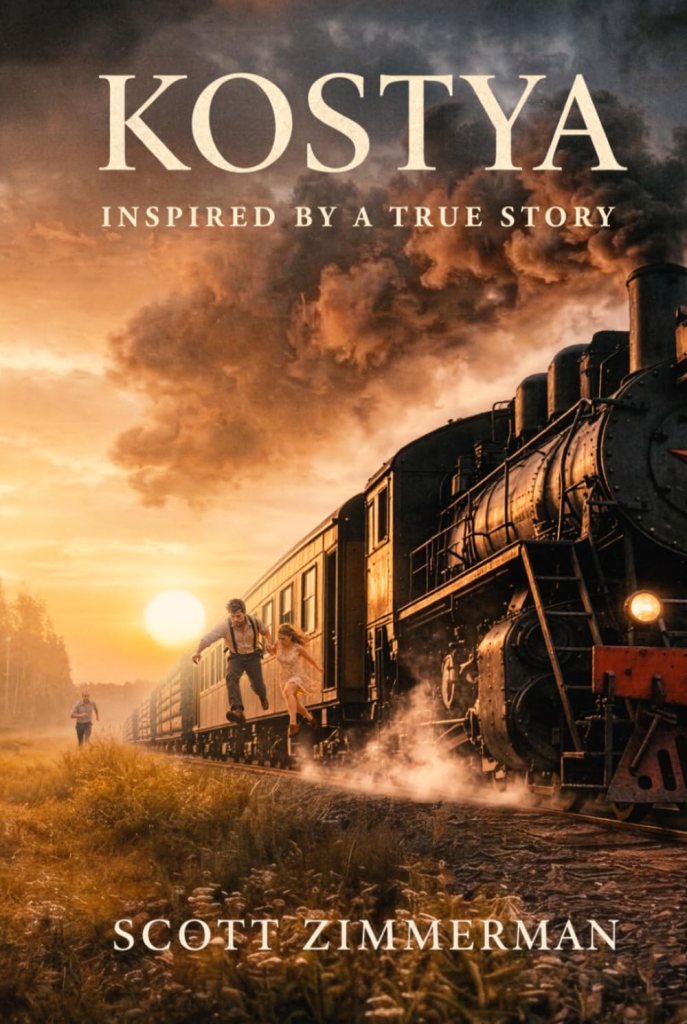
Book Details:
Author: Scott Zimmerman
Release Date: 20 April 2026Series:
Genre: Historical Fiction, Thriller
Format: E-book
Pages: 371 pages
Publisher: Kostya Publishing
Blurb:
He survived genocide. Nazis. Stalin. Now he’s being hunted.
Kostya is a Ukrainian boy who endures brutal Nazi forced labor, Allied bombings, and Stalin’s enslavement in the Ural Mountains. When WWII ends, the danger doesn’t. He’s sent to a Soviet filtration camp. These were extreme and often fatal.
To escape in 1946, he races across Russia with the secret police closing in — jumping from trains, hiding in bombed-out barns — while falling in love. The romance will pull your heartstrings. But survival forces an impossible choice: break a promise he cannot betray, or lose everything.
A gripping true story of resilience, integrity, and extraordinary courage.
Review
Kostya by Scott Zimmerman is a powerful historical fiction novel inspired by the true story of Konstantin “Kostya” Lysenko, a Ukrainian boy whose life is shaped by the Holodomor, Nazi occupation, forced labour, imprisonment, escape, Soviet suspicion, and the long, almost impossible journey back home. Beginning in 1932 Mariupol, the novel immediately establishes itself as a story of survival under two brutal regimes: first Stalin’s engineered famine, then Hitler’s war machine.
What stood out to me was the book’s relentless sense of movement. Kostya’s journey takes him from famine-stricken Ukraine to German farms, coal mines, penal camps, bombed bridges, liberated territory, Soviet-controlled routes, interrogations, checkpoints, forests, and finally back toward Mariupol. The novel never allows survival to feel simple. Each escape leads to another danger and each liberation contains another trap. Zimmerman captures the terrible irony of Kostya’s life: he survives the Nazis, only to face new suspicion from the Soviet system he is technically supposed to belong to.
Kostya himself is a strong protagonist because he is not written as a superhuman hero. He is impatient, young, stubborn, frightened, sometimes naïve, but also observant, resilient, and morally anchored. His father’s lessons about integrity run through the novel like a silent moral thread. Again and again, Kostya is forced to ask what integrity means when the world has become lawless, when survival requires deception, and when every authority claims the right to own a person’s body.
The historical scope is one of the book’s greatest strengths. The early Holodomor chapters are especially devastating, showing starvation as real, bodily horror. Later, the sections in the German farm, Victoria Coal Mine, Wesel penal camp, and the bridge bombing are vivid, cinematic, and physically immersive. Author Zimmerman is particularly effective at showing systems: the Nazi machinery of forced labour, the Soviet bureaucracy of suspicion, and the way ordinary people are crushed between ideologies that destroy individual lives.
The book is also deeply interested in home; not as a sentimental destination, but as something almost mythic. For Kostya, home is memory, duty, promise, identity, and unfinished moral business. The ending, especially the small act of returning the buried tin can, is extremely beautiful. It does not erase what has happened, but it gives the story a rare moment of balance, as if one tiny moral debt can still be corrected in a world that has stolen almost everything.
That said, Kostya is a heavy and sometimes demanding read. The prose is direct and dramatic, and some historical explanations are presented quite explicitly, which may feel slightly expository to readers who prefer subtler integration of history into fiction. The novel’s structure is also episodic by nature, moving from crisis to crisis, which gives it momentum but occasionally reduces the space for subtler interior reflection. However, given the scale of the story and the extraordinary circumstances of Kostya’s survival, that forward-driving structure largely works.
Overall, Kostya is a gripping, humane, and emotionally resonant historical novel about endurance, moral courage, and the cost of surviving history’s most brutal machinery. It is painful, vivid, and often difficult to read, but also very worthwhile. Author Zimmerman honours Kostya by showing him as a boy and then a man who keeps choosing life, truth, and home even when every system around him tries to strip those things away.


I love reading your comments, so please go ahead…