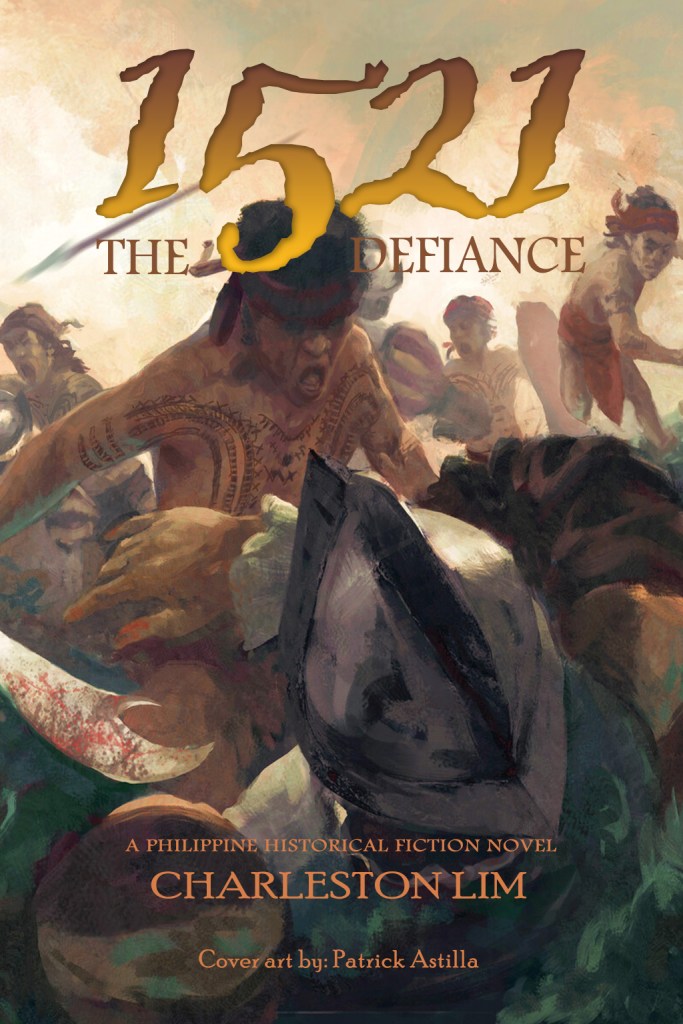
Book Details:
Author: Charleston Lim
Release Date: 15 April 2026Series:
Genre: Historical Fiction
Format: E-book
Pages: 243 pages
Publisher: –
Blurb:
History remembers the fall of Ferdinand Magellan, but it forgets the lives caught in his death’s shadow.
1521: The Defiance is not merely a retelling of the Battle of Mactan. It is a reckoning with how history is written, who is remembered, and whose stories endure.
Drawing from Antonio Pigafetta’s chronicle, the only surviving firsthand account of Magellan’s final expedition, and grounded in precolonial Visayan culture, this novel explores the lives, fears, and convictions of those who stood on both sides of this historic encounter between islanders and empire.
Written by a Filipino author rooted in the land where these events unfolded, 1521: The Defiance reimagines the human stories behind the clash, filling the silences between recorded facts with narrative, emotion, and cultural memory. It offers a perspective rarely centered in colonial histories, one that restores agency, dignity, and complexity to those long reduced to footnotes.
This is a story of belief and resistance, of men who sought to change the world, and of those who refused to let it be taken from them.
“Tell me, Antonio. What will your pages call him if we cannot make him bend?”
The Venetian hesitated, then gave a thin smile.
“A rebel, perhaps. Or a heathen. Or…”
He glanced at his parchment, as if unsure.
“Or a fool who defied destiny.”
A powerful tale of belief, resistance, and the cost of empire, this novel is for readers of immersive, multi-perspective historical fiction who seek stories that challenge inherited narratives.
Review
1521: The Defiance by Charleston Lim is an exceptionally vivid and atmospheric work of Philippine historical fiction that revisits one of the most defining encounters in the archipelago’s early colonial history: Ferdinand Magellan’s arrival in Cebu and his fatal confrontation with Lapulapu on the shores of Mactan. Rather than treating the Battle of Mactan as a simple heroic episode or a dry historical event, author Lim reimagines it as a layered clash of ambition, faith, politics, survival, and cultural sovereignty.
The novel’s greatest strength lies in its shifting perspectives. Lapulapu is rendered not merely as a symbol of resistance, but as a leader, husband, mentor, and protector of land and people. His bond with Amihan gives the story emotional tenderness, while his relationship with Bulakna adds subtle strength to the narrative. Magellan, meanwhile, is not flattened into a villain. He is written as a man of faith, pride, conviction, and dangerous certainty; someone who genuinely believes he is fulfilling a divine mission, even when that mission begins to resemble conquest.
I especially appreciated how the novel handles Enrique and Pigafetta. Enrique becomes one of the book’s most compelling figures because he exists between worlds: enslaved yet indispensable, familiar with the islanders yet bound to the Spanish expedition, translator of empire yet increasingly aware of what his translations help unleash. Pigafetta, on the other hand, brings the perspective of the chronicler: observant, fascinated, devout, sometimes prejudiced, and constantly trying to make history legible through his own worldview. Through these two figures, the novel beautifully explores how history is not only lived, but recorded, interpreted, and sometimes distorted.
The worldbuilding is rich and immersive. Author Lim pays close attention to pre-colonial Visayan culture, and the detailing does not feel decorative, it helps restore depth and dignity to a world too often reduced to a footnote in colonial narratives. The descriptions of the mangroves, reefs, villages, feasts, rituals, and battle preparations give the novel a strong sensory presence.
The Battle of Mactan itself is one of the most powerful sections of the book. Author Lim builds it carefully, showing both strategy and emotion. The death of Amihan gives the battle an intimate heartbreak, preventing it from becoming merely a triumphant historical set-piece. Victory here is meaningful, but never bloodless.
That said, the novel is at its strongest when it stays close to character and cultural tension. Some passages, especially those dealing with religious exposition and political explanation, can feel slightly heavy, and readers who prefer faster-paced historical fiction may find the build-up deliberate. However, this slower pace also allows the author to establish the stakes with care, making the eventual confrontation feel earned rather than rushed.
Overall, 1521: The Defiance is a thoughtful, well-researched, and emotionally resonant historical novel. It honours Lapulapu’s defiance while also examining the complicated motives of Magellan, Humabon, Enrique, Pigafetta, and the many people caught between faith, power, survival, and loyalty.


I love reading your comments, so please go ahead…