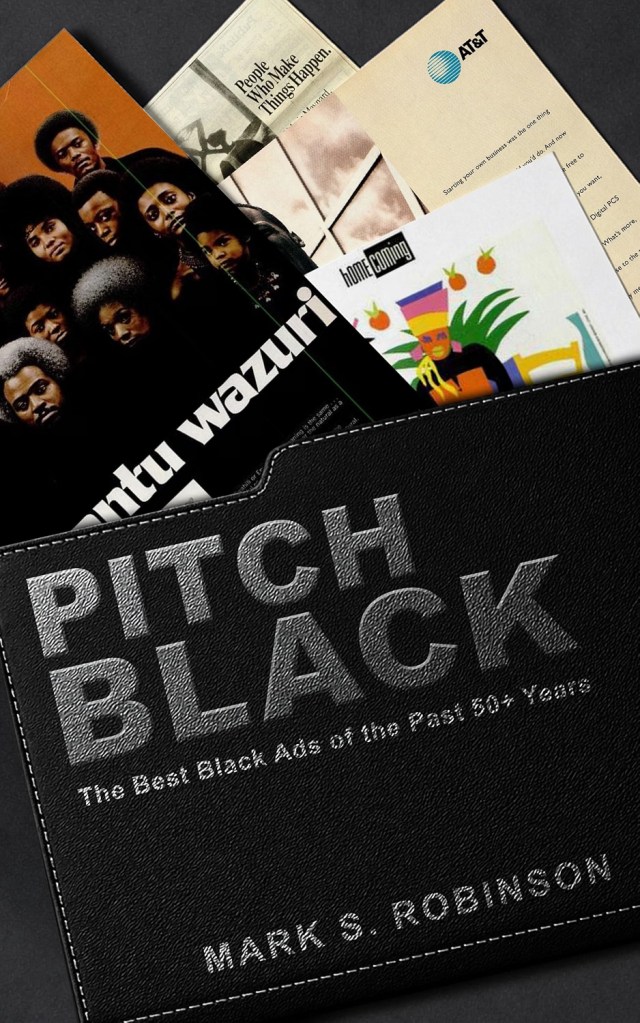
Book Details:
Author: Mark S. Robinson
Release Date: September 7, 2026Series:
Genre: Non-Fiction, Business, Advertising
Format: E-book
Pages: 179
Publisher: Alliance Books
Blurb:
What if the most influential architects of modern American pop culture weren’t the ad men of Mad Men, but the unsung Black creatives who built their own ad agencies in the shadows of Jim Crow?
“Pitch Black: The best Black ads of the past 50+ years,” a new book by author and advertising luminary, Mark Robinson, is destined to challenge what you think you know about American business, fashion and culture. “Pitch
Read full book blurb
“Pitch Black” reveals how advertising created by Black people and for Black people became one of the most effective tools – and weapons – of the Civil Rights movement, changing the world’s perception of Black America. Advertising enabled America to get to know Black people in ways that would have been impossible otherwise.
“Pitch Black” is a remarkable collection that cannot be found in any other book, library, or museum. Interspersed between chapters of historical narration, the beautiful “coffee table” book showcases the advertising images of the past 50 years and chronicles a previously unrecorded chapter of the history of American business, fashion and culture, revealing how Black identity, in all its freshness and different beauty, turned Blackness into a “brand” that America wanted to buy.
The book examines the history of Black America from a previously unexplored perspective.
Pitch Black
The secret weapon of the Civil Rights movement.
Invaluable reference tool. Cherished keepsake. Testament.
Review
Pitch Black: The Best Black Ads of the Past 50+ Years by Mark S. Robinson is a richly illustrated cultural and advertising history that traces how Black Americans moved from being caricatured, marginalised or used as props in commercial imagery to becoming the strategists, artists and agency founders shaping American brands and popular culture. Beginning with advertisements that presented Black people as servants rather than consumers, Robinson follows the long, difficult progression towards meaningful representation, creative authority and economic influence. His central argument is compelling: advertising does not merely reflect society; through repetition and reach, it helps determine whom society considers visible, aspirational and fully human.
Robinson brings considerable authority to this history after forty-five years in advertising, but his personal connection makes the book especially engaging. His mother, Rita Robinson, worked as a model, and he appeared beside his family in a 1966 Coca-Cola advertisement when he was nine. That experience adds warmth and immediacy to his accounts of pioneers such as David Sullivan, Edward Brandford, Vince Cullers, Tom Burrell and Caroline Jones. Rather than reducing their work to a succession of milestones, Robinson explains the economic and cultural structures they had to challenge—often producing outstanding campaigns with fewer resources while receiving little of the recognition routinely afforded to mainstream Madison Avenue agencies.
The visual archive is the book’s greatest pleasure and one of its most valuable achievements. Its decade-by-decade galleries allow readers to study how ideas of beauty, success, family, Black pride and cultural authenticity changed across more than fifty years. Robinson is equally perceptive when examining the contradictions within that progress. Tobacco, alcohol and fast-food companies were among the earliest advertisers to recognise Black consumers, but their investment frequently came with exploitation, stereotyping and serious consequences for the communities they targeted. Chapters on Black hair and beauty, civil-rights advertising, the commercial replacement of “Black” with the more ambiguous “urban”, and performative community relations demonstrate that inclusion is not necessarily the same as understanding, and representation without genuine cultural insight can still cause harm.
All in all Pitch Black is visually absorbing, intellectually accessible and historically necessary. It honours the ingenuity of Black advertising professionals without romanticising the industry in which they worked, and it asks readers to look beyond the people shown in an advertisement to consider who conceived it, who controlled its message and who benefited from its success. This is an important resource for readers interested in advertising, design, media, business and African American cultural history, and a persuasive record of work that deserves a far more prominent place in the history of American creativity.


I love reading your comments, so please go ahead…