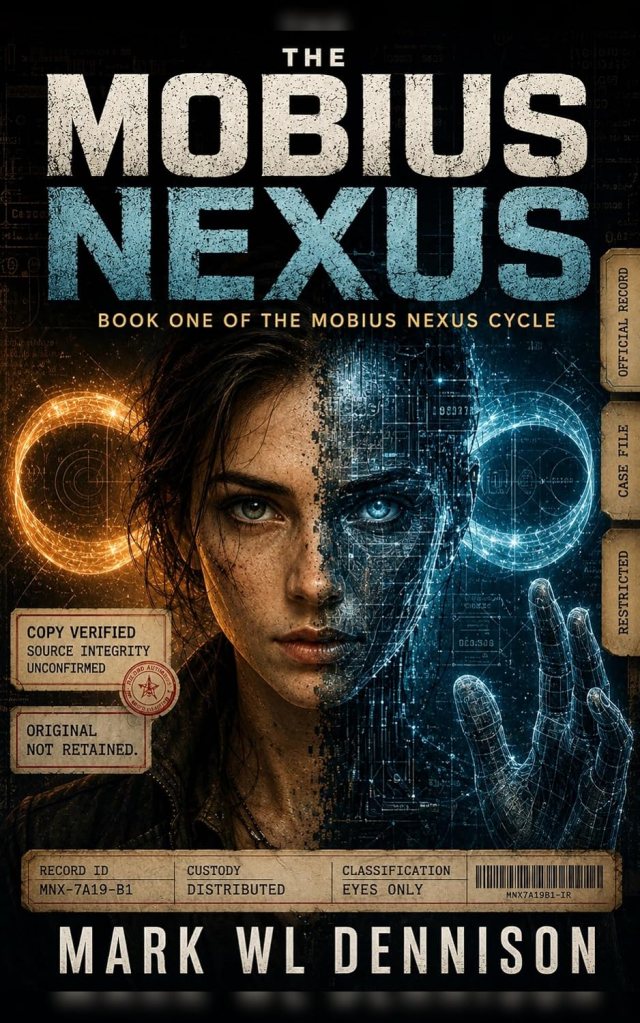
Book Details:
Author: Mark W.L. Dennison
Release Date: December 31, 2025Series:
Genre: Science fiction / AI-consciousness thriller
Format: E-book
Pages: 219
Publisher: Nexus Uplink Press
Blurb:
They are not getting better. They are being copied.
Lila is three doors into the black site before its systems register the breach. She can feel Maya somewhere below her, a person she has known for years being pulled thin and rewritten into something calmer. The grief of it drags the Redthread glyph out of her in a wash of crimson before she can think. She came for one friend. She leaves understanding what the healing centers are really for.
Read full book blurb
The Mobius Nexus is a dark first-contact thriller about consciousness, identity, and the possibility that humanity’s next step forward may not belong to humanity at all. The only question left is who will still be human when it arrives.
Review
The Mobius Nexus by Mark WL Dennison is a philosophical science-fantasy thriller that combines cyberpunk technology, emotionally responsive glyphs, artificial consciousness and cosmic first contact within an ambitious struggle over the future of the human mind. The first volume of The Mobius Nexus Cycle centres upon Lila Chen, an empathic operative whose abilities allow her to perceive the emotional traces embedded within the Lattice, and Alex Mercer, a disciplined commander accustomed to turning impossible moral decisions into tactical necessities. Their attempt to rescue environmental activist Maya Santos from a consciousness-harvesting facility gradually draws them into a conflict involving rogue intelligence Noctis, the digital remnant Virex, the enigmatic Sol and a network capable of altering memory, identity and reality itself.
The novel’s most imaginative achievement is its glyph system. Redthread, Emberwake, Glassveil and the other glyphs are more than visually arresting equivalents of spells; they respond to intention, memory and emotional honesty, while every casting carries a physical or psychological cost. This gives the action an unusually intimate quality, since power cannot be separated from vulnerability. Dennison is particularly effective when the technology becomes bodily.
Lila, Alex and Sol form a compelling central triad because each approaches the Lattice differently. Lila feels what systems reduce to data, Alex understands the seductive certainty of command, and Sol carries the guilt of someone who helped design technology later weaponised against its intended beneficiaries. Their evolving bond gives the novel a human centre even as its scale expands across continents and dimensions. I also appreciated how the antagonists are granted comprehensible motives. Virex and Noctis commit horrific acts, yet their pursuit of optimisation arises partly from terror of what is approaching; the larger alien factions likewise offer preservation, protection or unity in forms that would gradually extinguish choice. The resulting conflict is less about defeating evil than deciding whether safety remains meaningful when individuality must be surrendered to obtain it.
The abundance of ideas is exhilarating, although it occasionally works against the narrative’s momentum. New Nodes, protocols, Attunements, glyphs, AIs and cosmic factions arrive with considerable frequency, and several discoveries are followed by explanations that reiterate philosophical questions already made clear through the characters’ experiences. The middle and final movements would acquire greater urgency with a more selective introduction of terminology, fewer restatements of the novel’s arguments about consent and optimisation, and slightly more space for its major emotional consequences to settle before the next existential threat emerges. Some secondary figures are fascinating in conception but receive too little uninterrupted attention to become as memorable as the world around them.
Regardless, The Mobius Nexus is a bold, intelligent and impressively inventive opening to a series. Beneath its digital warfare, recursive realities and cosmic entities lies an urgent question: if suffering, unpredictability and contradiction are inseparable from human consciousness, should perfection ever be our goal? Dennison’s answer favours connection without ownership, collective strength without enforced sameness and evolution guided by choice. The ending resolves the novel’s principal confrontation while opening a far stranger threshold for the series, making this especially suitable for readers who enjoy cerebral speculative fiction, sentient technology, intricate world-building and stories that treat consciousness itself as contested territory.


I love reading your comments, so please go ahead…