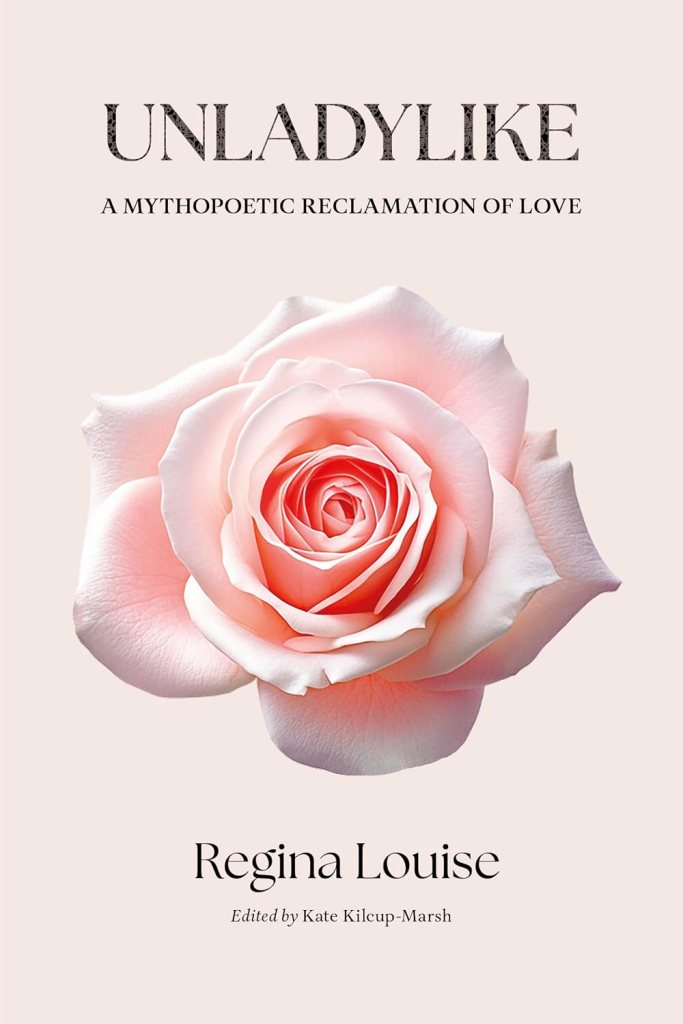
Book Details:
Author: Regina Louise
Release Date: June 19, 2026Series:
Genre: Contemporary Poetry, Women’s Poetry
Format: E-book
Pages: 154
Publisher: She Said So Press
Blurb:
Unladylike: A Mythopoetic Reclamation of Love is a lyrical and unflinching exploration of identity, survival, and self-return. Blending memoir, poetry, and myth, Regina Louise invites readers into an intimate landscape where the personal becomes archetypal and the body holds memory, truth, and transformation.
Through a series of evocative and emotionally precise pieces, the collection traces the subtle and overt ways women are conditioned to abandon themselves in pursuit
Read full book blurb
of love, belonging, and safety. What emerges is not only a reckoning with that inheritance, but a courageous reimagining of what it means to come home to oneself.
Rooted in lived experience yet expansive in its reach, Unladylike moves between tenderness and ferocity, grief and reclamation. Louise writes from the thresholds—where silence breaks, where longing reveals its cost, and where a new language of self-worth begins to take form. Her voice is both deeply personal and universally resonant, offering readers a mirror for their own unspoken truths.
This collection is not only a body of work—it is a map, a praxis. A cartography of becoming that honors the complexity of healing while refusing the narratives that diminish it. With clarity, compassion, and power, Unladylike asks what it means to choose oneself fully, and what becomes possible when we do.
For readers of contemporary poetry, memoir, and transformational writing, this book offers both witness and invitation: to remember, to reclaim, and to re-author the story of love.
Review
Unladylike: A Mythopoetic Reclamation of Love by Regina Louise is a fiercely intimate memoir-in-verse that examines childhood abandonment, institutionalisation, racialised girlhood, abusive love and the difficult journey towards self-possession. Organised as verses, refrains, a bridge and a final ceremony, the collection draws upon the architecture of music and ritual to trace a life repeatedly formed by the desire to be wanted. Louise writes from inside the body’s memory, showing how early deprivation can influence whom we trust, what we tolerate and how readily pain may be mistaken for proof of love.
The collection is at its most devastating when Louise exposes the treatment of Black girls whose fear and grief are interpreted as defiance. “Recipe for a Child Marked ‘Other’” uses the language of instructions to reveal how a grieving child can be processed, labelled and disciplined by institutions that never truly see her, while “The Alienation of a Girl” confronts the adultification that denies Black girls the softness and protection afforded to other children. These poems are emotionally forceful precisely because Louise allows bureaucratic language, inherited prejudice and lived experience to collide on the page.
Louise is equally compelling when writing about adult desire. She does not present herself as a flawless survivor who recognised every danger immediately; she examines the hunger that kept drawing her towards people who offered recognition while steadily eroding her boundaries. Sensuality, shame, wit and anger occupy the same emotional territory, giving poems such as “The Wedding Issue”, “I Stayed” and “I Was Your Queen” their uncomfortable complexity. I particularly admired the way Louise turns personal objects and physical details into evidence of the lives she imagined, endured and eventually chose to leave.
Unladylike is an arresting work of witness and reclamation, one that understands healing as the recovery of authorship rather than the erasure of what happened. Its closing movements transform confession into ceremony as Louise returns dignity, voice and protection to the selves she once sacrificed in exchange for belonging. This is demanding, frequently painful reading, yet it is also sensuous, intellectually searching and defiantly alive, a book for readers drawn to autobiographical poetry that speaks openly about race, foster care, domestic abuse, sexuality, intergenerational wounds and the radical labour of choosing oneself.
Content note: childhood abandonment, institutional abuse, domestic and sexual violence, coercive relationships, racism and trauma.


I love reading your comments, so please go ahead…