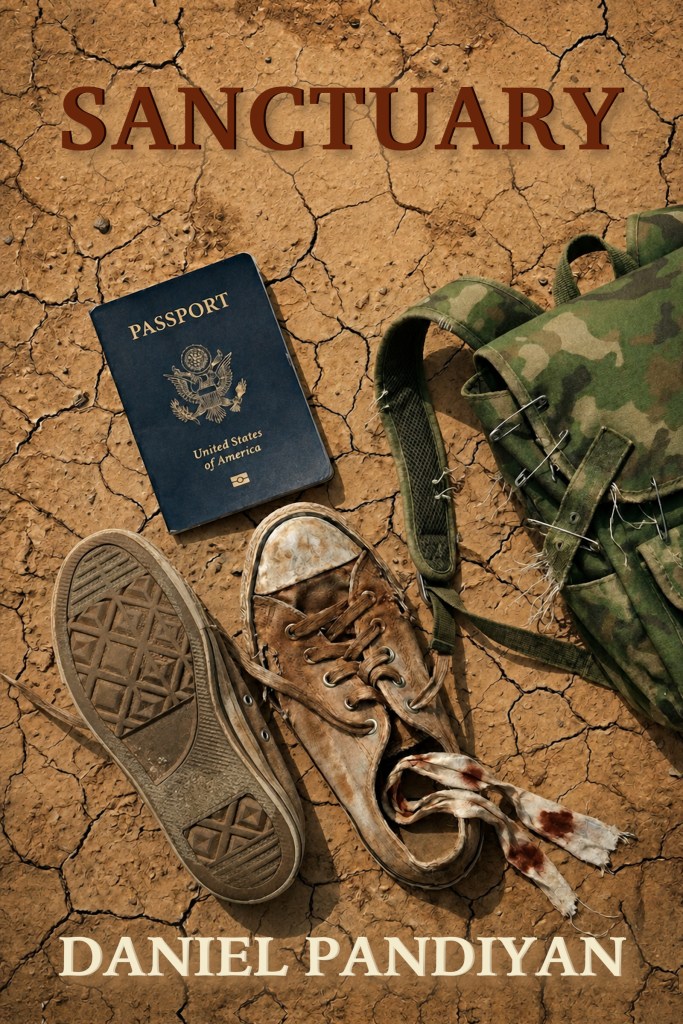
Book Details:
Author: Daniel Pandiyan
Release Date: November 12, 2026Series:
Genre: Literary Fiction, Immigration Literature
Format: E-book
Pages: 304
Publisher: Kedzie Press
Blurb:
Thirteen-year-old Miles Jensen sets out to walk three thousand miles north, from an orphanage in Costa Rica to a farm outside Oshkosh, Wisconsin.
When a solar storm burned out every circuit on Earth, the world stopped in an afternoon: planes down, grids dark, borders hardening. Miles was in Costa Rica with his
Read full book blurb
mother, counting the months until they would go home. One year, baby. Then we go home, she used to tell him. She did not survive that afternoon.
Eight months later he is the only American in an orphanage that is running out of food, where the older children are pushed out through the gate as they age. Then a letter arrives, hand-carried three thousand miles by strangers, addressed to a mother who is already dead. His grandparents are alive on their farm in Wisconsin. His sister is alive. Come home. We’re waiting.
No planes are flying. No one is coming for him. So Miles begins to walk.
He goes north with a sixteen-year-old Nicaraguan girl who has an aunt’s address in Los Angeles and no papers at all, and an American man who used to launder money for men who are still in business. Some of the danger is plain: hunger, checkpoints, bound wrists, men who take what they want. Some of it arrives as a contract, a fee, a clerk who is only doing his job.
Miles is the only one of them carrying papers that prove he belongs somewhere. The road teaches him exactly what that is worth, and then it asks him to help.
Sanctuary is a debut novel about migration told in reverse. It is about complicity and the cost of survival: what a document is worth, who is ever asked for one, and how many decent people have to look away for a system to keep running.
For readers of The Underground Railroad, Never Let Me Go, and Beasts of No Nation.
Review
Sanctuary by Daniel Pandiyan is a post-apocalyptic survival novel that follows thirteen-year-old Miles Jensen as he attempts to travel from Costa Rica to his grandparents’ home in Wisconsin after a catastrophic solar flare destroys the world’s electronic infrastructure. With his mother dead and food at the orphanage running out, Miles begins the long journey north alongside Lucía and Carlos, two young Nicaraguans searching for uncertain futures of their own. What follows is an exhausting passage through borders, abandoned communities, gang-controlled territories and fragile places of refuge, during which Miles gradually discovers that an American passport may open doors for him that remain firmly closed to the people keeping him alive.
Pandiyan’s most compelling achievement is the way he reverses a familiar migration narrative, placing an American child among those walking north while allowing him to retain the privilege of citizenship even after almost every other form of security has disappeared. Miles begins with a comparatively simple understanding of right and wrong, but hunger steadily strips away the comfort of moral certainty. Lucía brings warmth, intelligence and moral clarity to this increasingly brutal world, while Elias is a particularly absorbing creation, a protector capable of genuine tenderness and terrible violence, carrying both the practical knowledge the children need and a past that makes trusting him perilous. Their evolving relationship gives the novel its emotional centre.
The novel is also impressively alert to the systems that survive catastrophe. Governments may collapse and technology may vanish, yet borders, labour exploitation, institutional prejudice and the language used to make cruelty appear lawful remain disturbingly resilient. The later chapters develop this idea with considerable force, showing how promises of employment, documentation and safety can conceal forms of ownership more effective than chains because every injustice has been authorised by a contract. Pandiyan balances this political anger with memorable images of generosity and cultural endurance.
The journey’s episodic structure does occasionally become repetitive, as refuge repeatedly gives way to violence, captivity and another escape, while certain political ideas are articulated through lengthy conversations after the narrative has already illustrated them very effectively. A little compression in the middle and greater confidence in the reader to recognise the implications of events would have sharpened the momentum and allowed the most harrowing episodes to retain even more of their individual force. The novel also contains graphic violence, sexual exploitation and the endangerment of children, so readers should approach it prepared for material considerably darker than Miles’s age might initially suggest.
Nevertheless, Sanctuary is an ambitious, emotionally confronting and morally serious novel that refuses to confuse reaching one’s country with reaching safety. Its final movement transforms Miles’s personal search for home into a much larger reckoning with the comfort purchased through unseen suffering, ending on an unresolved yet thematically powerful note. Pandiyan leaves us with a deeply uncomfortable question: when an unjust system benefits the people we love, and perhaps benefits us as well, how much are we truly willing to surrender in order to oppose it?


I love reading your comments, so please go ahead…