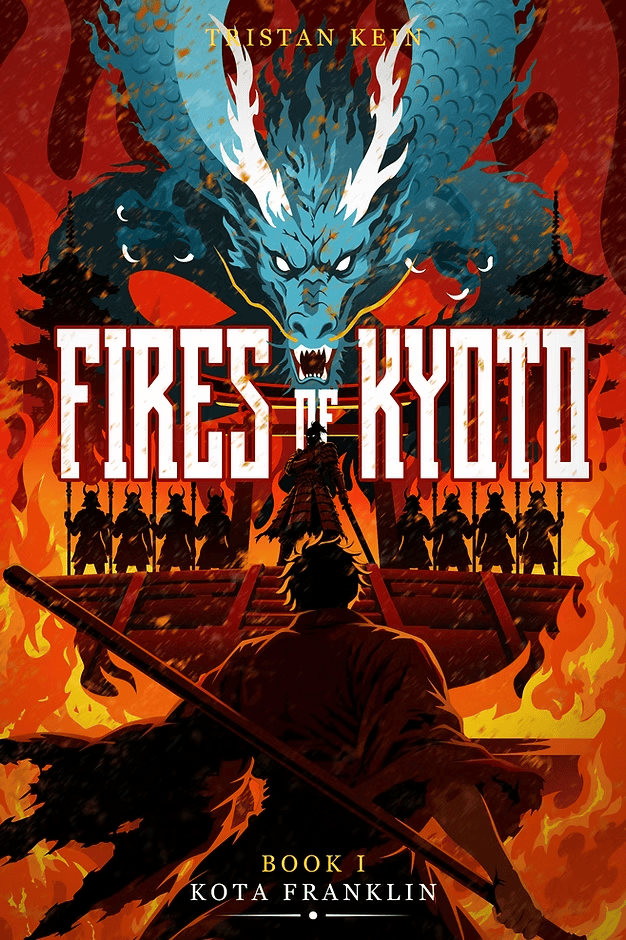
Book Details:
Author: Tristan Kein
Release Date: January 30, 2025
Series: Kota Franklin (Book #1)
Genre: YA Fantasy, Action, Adventure
Format: E-book
Pages: 606 pages
Publisher:
Blurb:
For sixteen-year-old Kota Franklin, summer break has been nothing short of miserable.
First, there was the head-slurping freak at the theater, the one that left Kota a viral sensation throwing popcorn at thin air like a maniac. Then, his girlfriend dumped him, because who wants to deal with a head case screaming about monsters no one else can see?
Read full book blurb
But the icing on the cake had to be getting hauled to the other side of the world by his mom to help clean up her childhood home; an old Shinto Shrine on the outskirts of Kyoto, Japan, ran by his grandpa, Gyo, a gruff old man who’s only hobbies seem to be burying his long lost grandson neck deep in back-breaking chores and piling weird sketches in his room.
If polishing floors and sweeping mountains’ worth of steps weren’t enough, now Kota’s seeing visions again, like swarms of paper tags dive-bombing his head, and a masked psycho coming out of the toilet…only this one’s real! And it’s got his mom!
Sucked into a world of unfamiliar gods and monsters, Kota finds himself a captive in the fortress prison Jigoku, headed by the terrifying, bull-faced warden, Gozu. To escape, Kota must team up with the savage weasel spirit, Hiroto, and the dangerously alluring fox princess, Chiaki, each with powers and secrets that could derail Kota’s chances of saving his mom from the clutches of an enormous toad lord in the heart of Heaven’s capital; Kyoto, the seat of the gods.
How far can Kota trust his new companions or himself as the three attempt to infiltrate the most impregnable city on either side of reality?
And…what if success means Kota becomes a threat to existence itself?
YOU WON’T WANNA MISS ALL THE FUN, EXCITEMENT, SCARES, AND MYSTERIES IN THIS BLAZING ACTION ADVENTURE. COME CHECK IT OUT!
Review
Fires of Kyoto by Tristan Kein is a young-adult portal fantasy that draws upon Japanese mythology to tell an action-filled story about identity, family and the dangerous consequences of dividing two interconnected worlds. The novel’s greatest strength is the sheer imaginative scope of its mythological world. Kein brings together kitsune, kamaitachi, tengu, jorogumo, kappa, mizuchi, aka manto and numerous kami without treating them merely as decorative monsters. Each possesses its own history, loyalties and relationship with the conflict between Heaven and the yokai resistance.
From the lava-ringed prison of Jigoku and the divided streets of Kyoto to the depths of Lake Biwa and the unsettling palace of Enma, the settings continually expand the scale of Kota’s journey. The glossary is particularly useful for readers unfamiliar with the extensive Japanese terminology and folklore woven throughout the book.
Kota’s relationships give this sprawling adventure its emotional centre. Hiroto’s irreverent humour conceals genuine loyalty and an affecting personal history, while Chiaki develops from a mistrusted kitsune princess into a brave, complicated companion whose growing connection with Kota carries warmth, friction and romantic promise. Miko is equally important: she remains resourceful and protective rather than becoming a passive objective in her son’s rescue mission. Most compellingly, Kota’s experience as a biracial teenager distanced from his Japanese heritage mirrors the separation between the human and spirit realms. His evolving understanding of his mother, grandfather and inherited power therefore feels like a cultural and familial reckoning as much as a supernatural awakening.
A minor problem I noticed was that the novel’s ambition occasionally works against its momentum. At more than six hundred pages, the journey contains several extended pursuits, battles and comic exchanges that revisit similar emotional or tactical ground, while the abundance of terminology and explanatory dialogue can make an already elaborate world feel even denser. A more selective approach to the repeated confrontations, insults and travelling sequences would allow the strongest revelations, and the consequences of the characters’ losses, to resonate more fully. The shifts between brutal violence, romantic awkwardness and broad comedy can also be abrupt, occasionally diminishing the gravity of scenes that deserve more room to settle.
Even with these excesses, Fires of Kyoto remains an energetic and heartfelt opening to the Kota Franklin series. Its immediate rescue story reaches a meaningful conclusion, while Kota’s relationship with Chiaki, the instability of Heaven’s Wall and the conflict surrounding his divine identity create ample ground for the next volume. Readers who enjoy mythology-rich fantasy, elaborate magical battles, found-family relationships and heroes discovering that their supposed weaknesses conceal extraordinary power should find much to appreciate here.


I love reading your comments, so please go ahead…