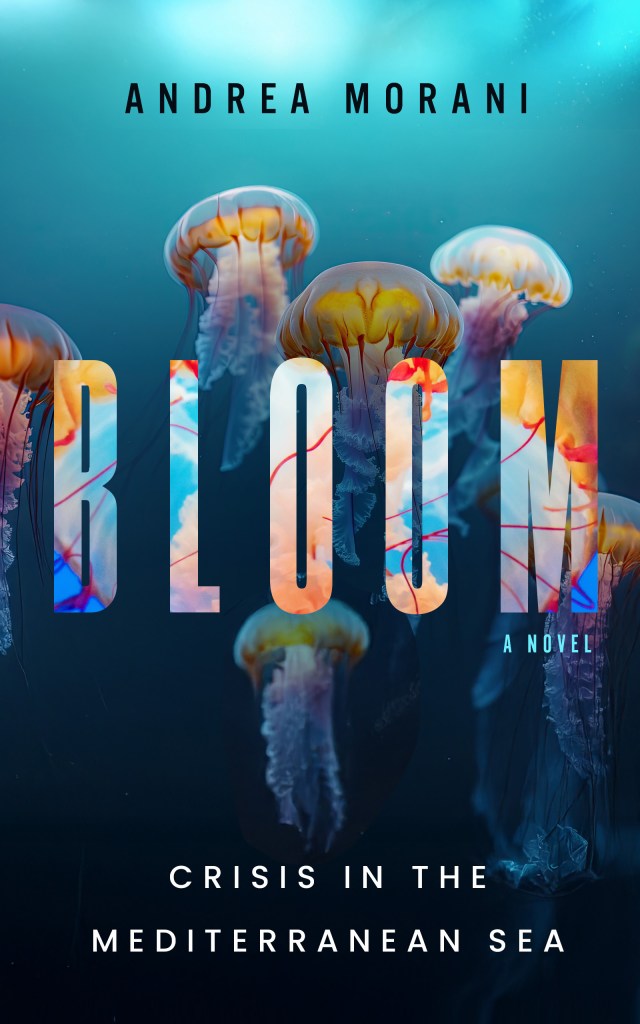
Book Details:
Author: Andrea Morani
Release Date: August 5, 2026Series:
Genre: Hard Science Eco-Thriller, Techno Thriller
Format: E-book
Pages: 292 pages
Publisher: –
Blurb:
SOMETHING IS SPREADING BENEATH THE SURFACE
Along the Mediterranean coast, people are dying or falling ill. Marine life is vanishing. The sea, once a source of life, is becoming a silent threat. No one knows why—or how far it will go. Called in to investigate, Dr. Marco Fassi and his team of scientists uncover unsettling patterns that point to something vast and unseen, pulsing beneath the water. As the phenomenon spreads, they’re forced to confront the…
Read full book blurb
terrifying possibility that nature itself is no longer under control.
For fans of Michael Crichton, Franck Schätzing, and eco thrillers grounded in real science, BLOOM delivers a chilling, high stakes mystery where the natural world becomes the greatest threat. Propulsive and eerily plausible, this gripping novel will leave you questioning what lies beneath the surface
Review
Bloom: Crisis in the Mediterranean Sea by Andrea Morani is a science-driven ecological thriller that transforms a harmful algal bloom into a rapidly escalating international catastrophe. The crisis begins along the Mediterranean coast, where dead marine animals, inexplicable respiratory failure and violent neurological symptoms shatter the lives of tourists and local communities. Professor Marco Fassi, an Italian marine biologist working in London, is summoned to join an international team of scientists investigating the disaster. What initially resembles an unusually severe outbreak of paralytic shellfish poisoning soon reveals something far more dangerous: a mutated form of Alexandrium catenella capable of producing lethal toxins, spreading with extraordinary speed and altering the behaviour of the animals it infects.
Morani’s scientific background, a degree in molecular biology and a PhD in Medical Sciences, is evident throughout the novel. The discussions of phytoplankton, saxitoxin, horizontal gene transfer, synthetic microorganisms and marine ecosystems are central components of the plot rather than decorative scientific terminology. I particularly enjoyed observing the researchers develop, test and revise their hypotheses as new evidence emerged. Their first solutions do not conveniently succeed, and the differences between controlled laboratory experiments and an unpredictable natural ecosystem create some of the book’s most intellectually engaging tension. The references provided at the end further demonstrate the factual foundations from which the author constructs their fictional ecological emergency.
The novel is equally effective when it allows the scientific threat to become immediate and physical. The research vessel Seagull provides an excellent central setting, bringing together scientists from different countries while isolating them within the very environment they are trying to understand. The political dimension also expands the stakes effectively.
Beneath the global emergency, Morani attempts to present a more personal story through Marco’s strained marriage, his devotion to his daughter and his growing attraction to fellow scientist Karen. Marco’s guilt, both professional and romantic, adds complexity to a protagonist who might otherwise have become an uncomplicated scientific hero. However, the romantic thread occasionally occupies too much narrative space during the most urgent stages of the environmental crisis, and its ethical implications could have been examined with greater depth. The novel would also benefit from a more selective approach to exposition. Scientific concepts are sometimes explained repeatedly, while extensive geographical descriptions, professional biographies and procedural details delay scenes that already possess considerable dramatic force. A leaner narrative would allow the discoveries, failed experiments and increasingly frightening consequences to generate even greater momentum.
Nevertheless, Bloom is an ambitious and research-rich ecological thriller with a genuinely alarming central idea. Its most disturbing suggestion is that humanity understands only a fraction of the natural systems upon which it depends, and that rising temperatures, pollution and well-intentioned scientific interference may interact in ways no model can anticipate. Morani balances scientific investigation with large-scale disaster, political conflict and several memorable scenes of survival, while ultimately affirming the value of collaboration, intellectual humility and responsible innovation. Readers who enjoy environmental thrillers, speculative science and stories about experts racing to prevent a plausible catastrophe should find much here to fascinate them.


I love reading your comments, so please go ahead…