Welcome to TRB Lounge. Today, I’d like to welcome Barrie Cole, author of Lacquer is a Thrilling Word, for an author interview with The Reading Bud.
About The Author

Barrie Cole
Barrie Cole is a Chicago-based playwright, poet, essayist, and instructor with more than three decades of experience. During her 30-year career, Barrie has amassed a catalog of more than a dozen plays, hybrid works, poems, and monologues that have been performed throughout the United States. In 2024, she received critical acclaim for five plays: Reality is an Activity, Capacity, Meaning is Tricky, Elevator Tours, and Fruit Tree Backpack, which were performed as part of a month-long festival by two collaborating theatre companies. Now focusing primarily on poetry, Barrie’s work revels in the power of language. Barrie’s first book, Lacquer is a Thrilling Word is now available from Finishing Line Press.
You can find author Cole here:
Website | Substack
Interview
Welcome to TRB! In addition to your formal bio, could you share a deeper, more personal insight into your life that influences your poetry?
Poetry demands a deep, specific, and curious kind of attention. Poetry has forms to honor and forms to push against. Poetry works with images first experienced in the world and then struggled with, confronted, magnified, described, and altered. Writing poetry requires gameness- readiness. I like the marriage in writing between decision-making and surrender.
Beyond the general overview, could you delve into the themes, emotions, or experiences that inspired your latest collection of poems?
The book is a celebration of language, imagination, and sensation.
Poetry often reflects deep personal feelings or insights. What specific emotions or experiences drove you to write the poems in your book?
Awe, overwhelm, and a need to describe. Wallace Stevens said “Description is revelation” I agree. I use poems to digest and metabolize experience. Poetry is a conversation with my inner life as well as the outer world. It is about finding words for other words, structures, concepts, metaphors, music, and connectivity.
Many poets have a defining moment or influence that shapes their work. Can you describe what sparked your journey into poetry?
I remember reading a book of poems for children called “A Box of Peppermints” when I was six. That book introduced me to the kind of heightened reading experience good poetry can deliver. I also really loved words, metaphors, rhythm, song, call and response – all the stuff of poetry.
From initial inspiration to the published collection, how long was your creative process for this book of poetry?
That’s a hard one to answer because if you look at it one way the book took 30 years to write, and in another, about 18 months. Both are true. I decided to submit a poetry manuscript for a few different reasons. First, I thought it would help me put together a manuscript. Two, I wanted to restart the submission process which had not been part of my regular routine for many years. I was writing plays, monologues, and stories, and poems. My writing life had more breadth than depth. Now, it’s the opposite.
Looking forward, what are your aspirations as a poet? Where do you see yourself in the literary world in the next five years?
It took me a long time to allow poetry to be the central focus of my writing. I see myself trying out new techniques, taking workshops, publishing books and chap books, applying for residencies, and more. I also would love to have my collection of plays and monologues published, which is called Fascinating Mistakes as well as other collections.
Are there new themes or styles of poetry you are currently exploring or plan to explore in your future works?
Yes, I’m excited about Haibun because I like Haiku and prose poems so much. I love the joining of both forms in a Haibun. I also just completed 100 Haiku and would like to write 100 limericks next. I love constraints. I also think writing in form is like a poetry workout. Even if I don’t love all the results, I’m exercising a muscle. I also really like invented and borrowed forms. I’m writing more long run-on style poems for tape measures. The lines are revealed as the tape stretches out. I am also working on new drive-thru poems, fortune poems similar to the poems that appear in my book, and imagined horoscopes.
While your primary focus is poetry, have you ever considered or dabbled in other literary forms, like fiction or non-fiction?
Yes, all of these. I have written plays and numerous essays and stories, too. I was also a ghost writer for many years and I worked on all kinds of projects.
Describe your poetic process. Do you follow specific routines or practices that help you capture your thoughts and emotions effectively?
Yes, I use multiple strategies: timed prompts, prepared notebooks, the alphabet as a structure to circle around a subject, lists of random words, walking frameworks, reading frameworks, and many other strategies. I write with others a few times a week or more.
Aside from poetry, do you engage in other professions or hobbies that influence or enrich your writing?
Yes, I have an aquarium and a garden. I love to watch animals and plants. I am lucky enough to regularly hang out with a two-year and I love seeing her see things in the world for the first time. My partner is a language teacher so he and I inspire each other, and my two grown children who are in their 20s inspire me constantly.
Considering the themes in your poetry, can you recommend a few other poets or poetry collections that resonate with similar sentiments?
Gabrielle Calvocoressi, Jason Shneiderman, Diane Seuss, Ellen Bass, Marie Howe, Mary Ruefle, Tony Hoagland, Dorianne Laux, Mary Oliver, Toni Morrison, Gertrude Stein, Tony Hoagland, James Baldwin, Clarice Lispector, Virginia Woolf, and many more.
Poetry sometimes touches on sensitive or controversial subjects. How do you address potential criticism or differing interpretations from your readers?
When it comes to poetry, I don’t believe there are any subjects that are off-limits but I do believe if a poem is being taken in a way that is vastly different from what I’d intended, especially by more than one person, I need to address it in revisions. Poems often have multiple interpretations and I celebrate this about poetry. I also think poems are conversations between the poet and the reader. The best conversations happen in a field of receptivity. I don’t worry much about what people who don’t like poetry think about my poems.
For aspiring poets, what essential advice would you offer for their journey into the world of poetry writing?
Read poems constantly. Copy poems word for word. Give yourself formal assignments. Write with other people.
Thank you, author Cole, for taking the time to answer our questions and for all your inspiring and insightful answers!
About the Book
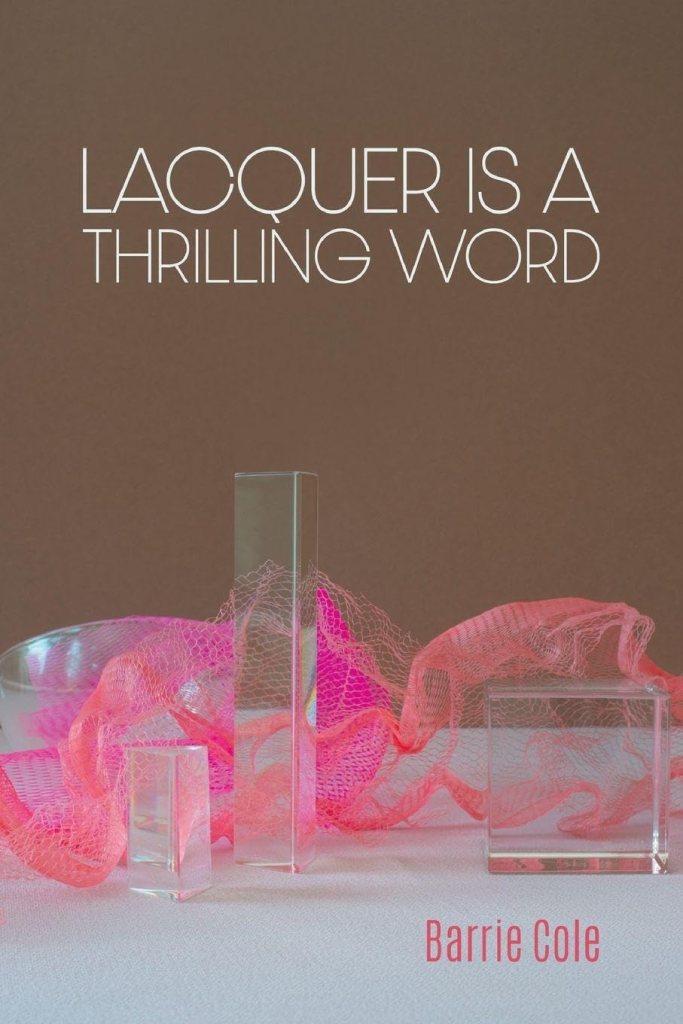
Lacquer is a Thrilling Word
Barrie Cole’s Lacquer is a Thrilling Word, invites readers to immerse themselves in the sublimity of language through unconventional forms and inventive metaphors. In this full-length collection of poems and short prose, Cole’s signature word play and strange takes can be found in to-do lists, fortune cookie fortunes, run-on sentences, and more. Each poem somersaults toward the places where the beauty and absurdity in living are revealed in equal parts.
You can find Lacquer is a Thrilling Word here:
Finishing Line Press
If you are an author and wish to be featured as our guest or if you are a publicist and want to get your author featured on TRB, then please get in touch directly by e-mail at thereadingbud@gmail.com


I love reading your comments, so please go ahead…