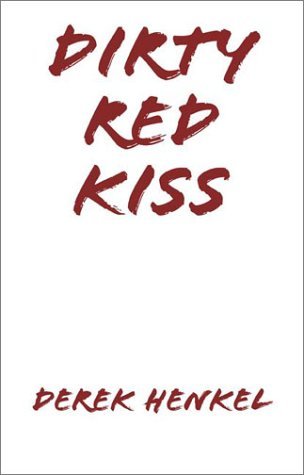
Book Details:
Author: Derek Henkel
Release Date: April 2001Series:
Genre: Literary Fiction
Format: E-book
Pages: 116 pages
Publisher: Xlibris Corporation
Blurb:
Dirty Red Kiss is an entertaining and emotional chronicle of a brief relationship between a young man and woman. It is set in San Francisco, and incorporates observations on the single life and urban culture.
Review
Dirty Red Kiss by Derek Henkel is a raw, strange, darkly comic literary novel about loneliness, desire, and the psychic aftershocks of divorce. Written in a confessional first-person style, the book follows an unnamed white narrator living in San Francisco’s Mission District after the collapse of his marriage. His life is fragmented into bus rides, cheap food, strange jobs, late-night walks, clubs, bars, uncomfortable encounters, and an increasingly obsessive relationship with a woman known only as E.
This is not a plot-heavy novel in the conventional sense. Instead, it reads like a long, feverish monologue from a man trying to narrate himself back into coherence. The narrator moves through the city observing everything: people on buses, homeless individuals, sex workers, tourists, co-workers, musicians, fringe subcultures, corner stores, theatres, rock clubs, and the changing neighbourhood around him. San Francisco is not romanticised here. It is dirty, vivid, crowded, lonely, funny, hostile, tender, and alive with uncomfortable contradictions.
The strongest element of the novel is its voice. Author Henkel’s narrator is compulsively observant, often funny, often offensive, sometimes unexpectedly tender, and quietly unreliable. His thoughts move in abrupt loops. The prose has a restless, diaristic rhythm, and its power lies in how directly it captures a mind that is both self-aware and profoundly disordered.
E is the emotional centre of the book, though she remains elusive, theatrical, unpredictable, and unsettling. The narrator describes her less as a fully knowable person and more as a mirror, addiction, fantasy, provocation, and wound. Their relationship is charged with flirtation, cruelty, performance, sexual tension, physical aggression, and emotional dependency. The title’s “dirty red kiss” becomes a fitting image for the novel’s idea of intimacy: passionate, bruising, messy, and never entirely clean.
What makes the book interesting is also what makes it difficult. The narrator’s language around race is blunt, repetitive, and deliberately uncomfortable. He categorises people by colour throughout the novel (White, Brown, Black, Yellow, and Red) in a way that exposes both his awareness of race and his inability to move beyond reductive seeing. This may alienate many readers, and understandably so. However, the book appears to use this discomfort as part of its character study: we are inside the mind of someone observing the city through fractured, prejudiced, class-conscious, lonely, and often defensive filters.
The novel is also sharply attentive to class. The narrator’s fall from domestic stability into shared housing, buses, cheap food, poor neighbourhoods, and emotional precarity gives the book much of its texture. His fixation on food, cars, rooms, grocery stores, rent, work, and neighbourhood difference is not incidental. It reflects a man who has lost the structure of his old life and is now forced to see the material fragility he once ignored. Some of the most affecting passages are about small humiliations like not having a car, eating badly, living with a roommate, waiting too long, walking too much, and feeling that one’s life has become provisional.
That said, Dirty Red Kiss is not a comfortable or traditionally polished read. Its repetitions, digressions, racial shorthand, sexual observations, and occasional crudeness may frustrate readers who prefer cleaner narrative arcs or more sympathetic protagonists. The narrator can be exhausting, and the episodic structure sometimes feels deliberately meandering. But there is a clear artistic intention behind that sprawl: the book is less interested in neat storytelling than in capturing a particular mental and emotional state.
Overall, Dirty Red Kiss is an abrasive, intimate, and memorable work of urban literary fiction. It is funny, bleak, uncomfortable, and oddly vulnerable, with a narrator whose flaws are impossible to miss and whose pain is equally difficult to dismiss. It will appeal most to readers who enjoy confessional literary fiction, unreliable narrators, post-divorce emotional collapse, city novels, and character studies that are more interested in psychological truth than likability.


 The Reading Bud
I love reading your comments, so please go ahead…