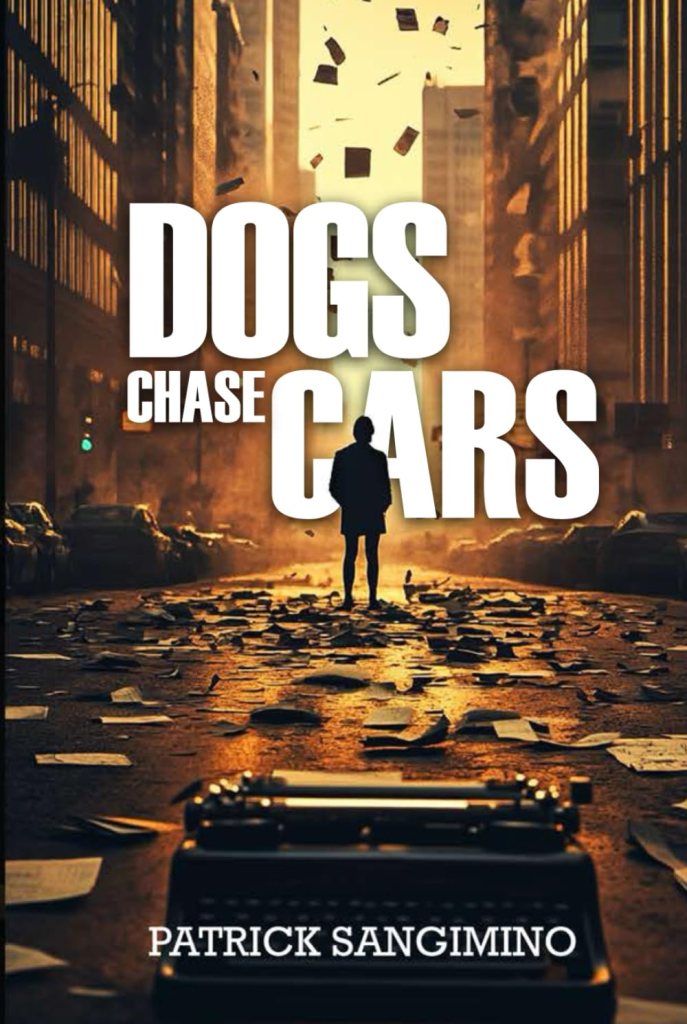
Book Details:
Author: Patrick Sangimino
Release Date: 24 March 2025Series:
Genre: Sports Biographies
Format: E-book
Pages: 389 pages
Publisher:
Blurb:
“Dogs Chase Cars” details the downturn in the newspaper industry through the eyes of a longtime Kansas City sports columnist, who is driving to work on a November Friday, expecting to be the latest casualty in a business that has shed far too much blood in recent years. It takes place over a single day, but flashes back to those seminal moments – from covering a World Series game in 1989 that was halted by a 7.1 earthquake to accidently breaking
Read full book blurb
the story of a Hall of Fame quarterback’s rumored trade while doing his business at a urinal – that stand out in a storied career. It’s a tale of changing times, changing technology and the ignorance and arrogance of the industry’s decision makers, who assumed the profits of the past would never wane.
Review
Dogs Chase Cars by Patrick Sangimino is a candid, nostalgic, frequently funny, and ultimately poignant reflection on journalism, ambition, ageing, family, regret, and the uncomfortable question of what remains when the career around which one has built an identity begins to disappear.
The novel follows J.P. Pasquale, an award-winning sports columnist who has spent more than three decades at the Olathe Daily News. Once celebrated as an indispensable voice in the community, J.P. now finds himself summoned to weekly meetings where he must justify his salary and relevance to an industry increasingly governed by online traffic, engagement metrics, shrinking budgets, and corporate anxiety. The immediate threat to his career provides the narrative’s present-day framework, while his drive to the newsroom and the tense Friday meeting prompt a long retrospective journey through the people and moments that shaped him.
J.P. is an engaging narrator because he is neither idealised nor falsely modest. He is witty, intelligent, nostalgic, egotistical, defensive, loyal, sentimental, occasionally abrasive, and painfully aware of many of his failures. His voice resembles the old-school newspaper columns he admires: expansive, anecdotal, opinionated, and determined to find the larger meaning within sport, work, and ordinary memory. Even when one disagrees with him, his personality remains vividly present on the page.
The title originates in a teacher’s cutting observation that dogs may chase cars without knowing what to do after catching them. It becomes an effective metaphor for J.P.’s life. He pursued the career he wanted, earned the respect he craved, married a woman he loved, became a father, and gained access to stadiums, athletes, historic events, and influential people. Yet possessing those things did not mean that he knew how to preserve them. The book is consequently less about failure to achieve than about the cost of achievement without sufficient emotional stewardship.
One of the novel’s greatest strengths is its portrait of newspaper culture. Author Sangimino writes with palpable affection for crowded newsrooms, irreverent colleagues, copy deadlines, handwritten letters from readers, local reporting, editors, press boxes, road trips, and the sense that journalism once represented both a public service and a shared vocation. The account of covering the 1989 World Series earthquake at Candlestick Park is especially memorable, combining professional exhilaration, communal fear, and the discovery that the most important story may exist beyond the scheduled event.
This affection is balanced by a persuasive lament for what the industry has lost. Empty reception desks, automated customer-service systems, disappearing employees, deteriorating offices, reduced budgets, and the elevation of clicks over craft become visible signs of a broader cultural erosion. J.P. does not merely resent technology because he is ageing; he grieves the disappearance of human contact, institutional memory, local accountability, and the relationship between a newspaper and its community.
The book is equally interested in mentorship. J.P.’s recollections of Herb Maris, his father Vincenzo, Tom O’Malley, and the editors and colleagues who recognised or shaped his talent give the narrative much of its emotional resonance. Herb’s career, particularly his dignified response to professional demotion, becomes an important counterpoint to J.P.’s fear of irrelevance. His father’s modest sacrifices carry even greater emotional weight because J.P. recognises their meaning only in retrospect.
His relationship with Lindsey supplies the novel’s most painful self-examination. J.P. speaks of her with love and admiration, but he also acknowledges that he repeatedly placed work ahead of marriage and fatherhood. He wanted professional freedom and domestic devotion without fully accepting the obligations of both. The novel does not erase his responsibility by presenting him as a victim of ambition. Instead, it allows him to recognise that the same qualities that made him a relentless journalist often made him an unreliable husband.
This self-awareness is not always complete, however, and that imperfection is important to the character. J.P. can identify his selfishness while continuing to indulge in digressions, judgments, and attitudes that reveal how deeply entrenched his worldview remains. Some of his descriptions of women lean heavily on appearance and sexuality, while certain comments about politics, gender, race, and younger generations may feel dated or unnecessarily provocative to contemporary readers. These moments are consistent with the narrator’s personality, but the distinction between character voice and authorial endorsement is not always sufficiently clear.
Structurally, the novel alternates between the precarious present and a wide-ranging recollection of J.P.’s personal and professional history. This allows the reader to understand why the possible loss of his position feels like more than unemployment: journalism has become his identity, mythology, community, and evidence of a life well spent. The movement between timelines also creates suspense around the Friday meeting and the future of the Daily News.
At the same time, the manuscript is considerably longer than its central narrative requires. Many sports histories, biographical sketches, political observations, and industry anecdotes are interesting individually, but not all of them deepen J.P.’s character or advance the emotional arc. Readers with a strong interest in American sports and newspaper journalism may enjoy this abundance; others may find that the main story periodically disappears beneath the volume of recollection. A more selective approach would have intensified the novel’s strongest themes.
Overall, Dogs Chase Cars is a heartfelt and highly personal novel about a man taking inventory of the life he built before someone else decides that his work, and perhaps his generation, has outlived its usefulness. It is both a love letter to newspaper journalism and a confession about what devotion to a profession can take away. Its humour, sporting knowledge, emotional candour, and deeply lived sense of place make it memorable, even when its expansiveness tests the reader’s patience.


I love reading your comments, so please go ahead…