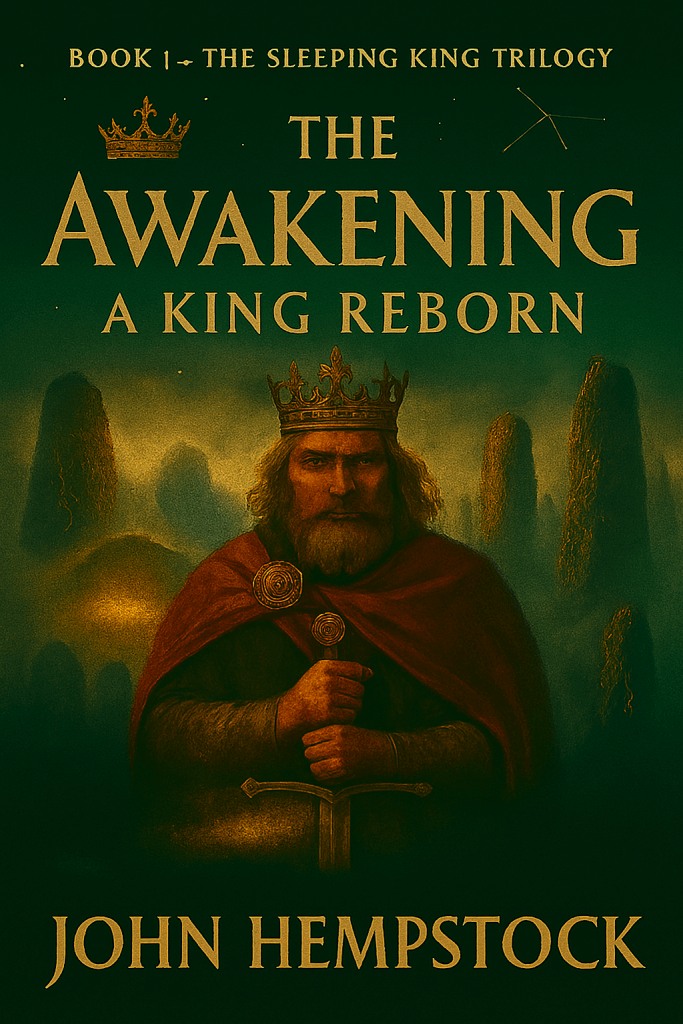
Book Details:
Author: John Hempstock
Release Date: 2026Series:
Genre: Epic Fantasy, Dark Fantasy
Format: E-book
Pages: 302 pages
Publisher: –
Blurb:
In a world where the dead march as an unstoppable Legion, one desperate prophecy offers humanity’s last hope—awaken the Sleeping King.
When the fortress city of Greykeep falls to Maltherion’s Deathless Legion, young scholar Kaelen Vross discovers an ancient prophecy hidden in forbidden texts. The legendary Aregor the Uniter isn’t dead—he sleeps beneath Silverwatch Hill, waiting to rise again when the world needs him most.
Read full book blurb
But waking a king who once united the realm through blood and conquest comes with a terrible price. As Kaelen assembles an unlikely fellowship—a battle-hardened commander, an elven ranger, a dwarf historian, and a street thief with unexpected destiny—they must face an impossible question: Is unleashing one tyrant the only way to stop another?
The dead are marching. The kingdoms are falling. And the cure might be worse than the disease.
An epic tale of desperate choices, unlikely heroes, and the price of salvation, THE AWAKENING launches an unforgettable fantasy trilogy about power, sacrifice, and what happens when prophecies come true.
Review
The Awakening: Book 1 of The Sleeping King Trilogy by John Hempstock is an ambitious epic fantasy novel built around one of the genre’s most compelling moral dilemmas: what happens when the only force powerful enough to defeat a monster may itself be monstrous? Set in a kingdom under siege by Maltherion and his terrifying Deathless Legion, the novel begins with the brutal fall of Greykeep and quickly expands into a story of prophecy, political desperation, ancient magic, uneasy fellowship, and the catastrophic burden of necessary choices.
The best aspect of The Awakening is its moral complexity. Aregor is not presented as a simple saviour. He was once the great unifier of kingdoms, but he also became a tyrant whose reign was marked by purges, dark magic, paranoia, and absolute control. The fellowship’s decision to wake him is therefore not heroic in the clean, triumphant sense. It is desperate. The novel repeatedly returns to the same painful question: is survival under tyranny preferable to annihilation under death? That question gives the book more weight than a straightforward “chosen king returns” fantasy.
The ensemble cast adds breadth to the story. Sera brings military realism and emotional trauma; Thane Ironfoot provides historical memory and hard-earned scepticism; Brother Aldric embodies faith and the burden of guardianship; Mira offers practical intelligence and loyalty; Lyra’s perspective complicates the ethics of waking Aregor; and Finn’s bloodline makes him both essential and vulnerable. Their uneasy fellowship works because they do not all believe the same thing. Some trust the prophecy, some fear it, some resent it, and some follow it only because the alternative is worse.
Author Hempstock’s worldbuilding is large in scale and classical in tone. The Deathless Legion, the sealed tomb beneath Silverwatch Hill, Eldrin’s prophecy, the old magical bindings, the seven kingdoms, the dwarf archives, the ancient guardians, and the idea of a king preserved for the world’s darkest hour all give the novel the feel of traditional epic fantasy. Readers who enjoy prophecies, ancient evils, lost histories, grim councils, battlefield strategy, and morally compromised legends will find much to appreciate here.
That said, The Awakening is a dense and sometimes repetitive read. The novel frequently restates its central dilemma (that Aregor is both necessary and dangerous) and while this reinforces the moral stakes, it also slows the pacing considerably. Another thing that I found problematic is that some conversations become heavily explanatory, with characters articulating themes and consequences very directly rather than allowing scenes to carry the full emotional weight. The prose is clear and accessible, but it occasionally leans toward summary and exposition where sharper scene-level tension would have made the story more immersive.
Still, the novel’s core idea is strong enough to carry its weight. Overall, The Awakening is a thoughtful, expansive, and morally charged opening to The Sleeping King Trilogy. It is best suited for readers who enjoy epic fantasy with ancient prophecies, undead armies, political desperation, morally ambiguous heroes, and the uneasy feeling that the cure may be only slightly less terrifying than the disease.


 The Reading Bud
I love reading your comments, so please go ahead…