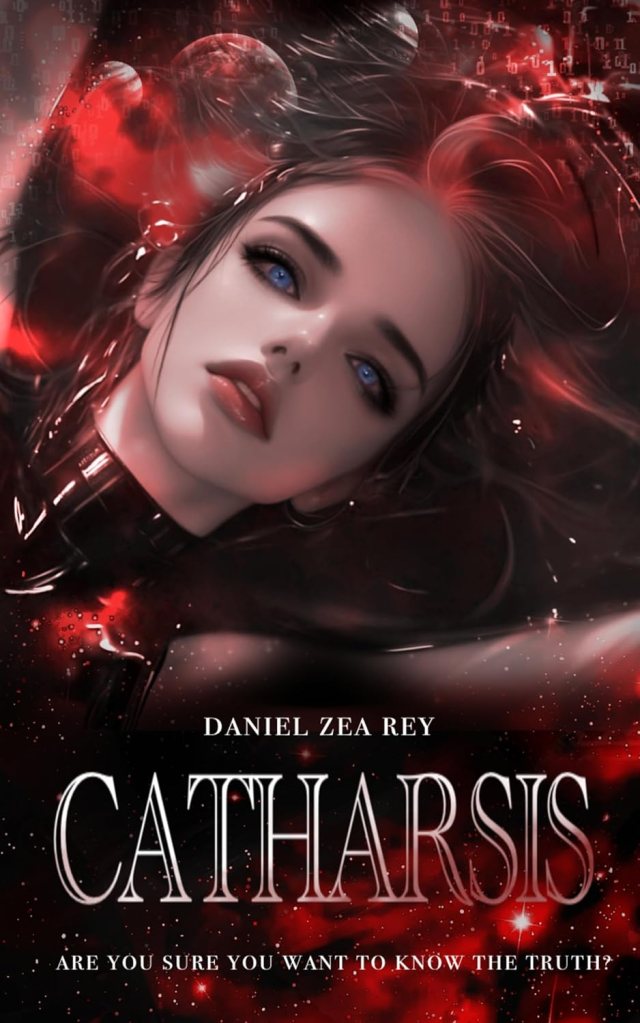
Book Details:
Author: Daniel Zea Ray
Release Date: 8 September 2025Series:
Genre: Science-Fiction, Romance, Cyberpunk
Format: E-book
Pages: 588 pages
Publisher: –
Blurb:
Catharsis is a thrilling blend of science fiction, epic adventure, and unforgettable romance.
Perfect for readers who love fast-paced sci-fi adventures, strong heroines, and romance that shines even in darkness.
Akreon, the last city on Earth, stands as humanity’s final sanctuary, shielded by a towering barrier that holds back the chaos beyond. Hardy Cain, a steadfast defender, has always been committed to protecting the city and its people. But when she is suddenly thrust beyond the barrier into a treacherous wasteland, …
Read full book blurb
survival becomes her ultimate test. Her only chance lies in an unlikely ally—someone who, just yesterday, was her sworn enemy. As the future hangs by a thread and her past pulls her into a labyrinth of buried truths, Hardy must navigate a world where reality and illusion collide. The secrets sheuncovers could change everything—or destroy what remains of humanity. Welcome to Catharsis—a gripping tale that will capture your imagination and plunge you into its intricate maze of secrets. Will you dare to unravel them all before the truth comes to light—or everything falls apart?
If you enjoy epic battles, emotional depth, and love that defies impossible odds, Catharsis will keep you turning the pages until the very end.
Review
Catharsis by Daniel Zea Ray is a dense, ambitious dystopian science-fiction novel built around grief, genetic engineering, political deception, and the painful dismantling of one woman’s entire understanding of reality. The story follows Hardy Cain, daughter of the celebrated engineer Robert Cain, whose life inside Akreon has been shaped by privilege, militarised duty, trauma, and carefully constructed belief. After she is betrayed and thrown beyond Akreon’s barrier, Hardy finds herself among the League, the very people she has been trained to hate.
The novel’s greatest strength lies in its worldbuilding. Akreon is presented as humanity’s final paradise. It is clean, efficient, technologically advanced, and protected from the poisoned world outside. But as Hardy experiences life in Lyre, the hidden city beyond the barrier, the moral certainty of Akreon begins to fracture. The book is particularly effective in showing how propaganda works through selective truth, social conditioning, and the repetition of inherited prejudice. The distinctions between humans, womb-borns, and synthetics give the story its philosophical depth, especially as Hardy is forced to confront what “human” really means.
Hardy is a difficult but compelling protagonist. She is arrogant, violent, sharp, traumatised, emotionally damaged, and often cruel, but the novel does not ask us to like her easily. Instead, it asks us to watch her unravel. Her grief over Jay, her lost child, and her father’s murder is tied to something much larger, and Hardy’s own erased memories turns the novel into a story about psychological violation. Hardy’s catharsis is not a neat healing arc; it is a brutal process of seeing.
Yona is one of the most interesting figures in the book. As a synthetic designed outside Akreon’s ordinary system of control, he carries the novel’s central contradiction: he is created, programmed, manipulated, and yet capable of attachment, defiance, pain, and moral choice. His relationship with Hardy is very uncomfortable, complicated by deception, programming, desire, grief, and power. The novel does not romanticise this dynamic in any simple way; it keeps returning to the disturbing question of whether love can remain love when it has been engineered.
The supporting cast adds texture to the world beyond Akreon. Satin’s awkward loyalty, Taito’s messy affection, Yeti’s bitterness, Rayne’s authority, Ruby’s innocence, Darmoy’s curiosity, and Lazarus’s cold intelligence all help turn Lyre into a living society rather than a mere rebel hideout. The scenes involving daily labour, rationing, makeshift repairs, markets, dancing, dining halls, prosthetics, caregivers, and children scarred by war are some of the book’s strongest passages because they ground the larger political conflict in ordinary survival.
That said, Catharsis is not an easy read. It is long, heavy, and sometimes overloaded with exposition. The dialogue often carries large amounts of worldbuilding, political explanation, emotional confrontation, and scientific theory, which can slow the pace. Some scenes are also intensely violent or sexually explicit, and the power dynamics around Hardy, Yona, Rayne, and Taito may be uncomfortable for many readers. The prose occasionally becomes repetitive, especially in scenes of interrogation, anger, and ideological debate. A tighter edit could have sharpened the pacing and allowed some revelations to land with greater force.
Still, the ambition of the novel is impressive. Beneath the violence, rebellion, and dystopian intrigue, Catharsis is ultimately about reality: who constructs it, who benefits from it, and what happens when a person discovers that their most intimate memories may have been designed by someone else.
Overall, Catharsis is a dark, complex, and emotionally abrasive dystopian sci-fi novel with a powerful central concept and an extremely layered moral universe. It will appeal most to readers who enjoy heavy speculative fiction, morally compromised protagonists, synthetic-human ethics, post-apocalyptic politics, and stories where truth is less a revelation than a wound.


I love reading your comments, so please go ahead…