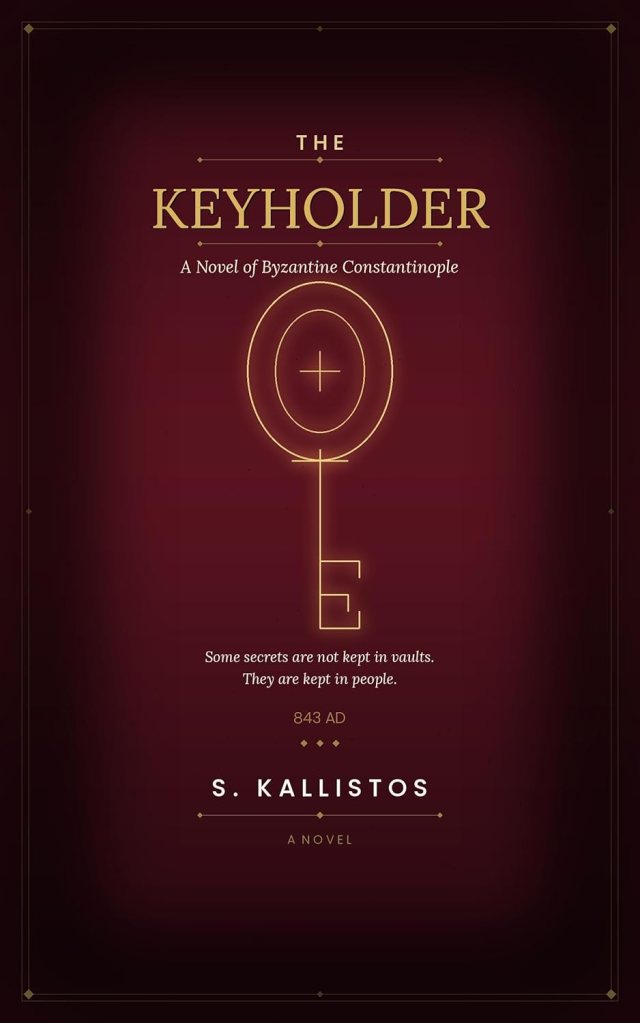
Book Details:
Author: S. Kallistos
Release Date: 21 March 2026Series:
Genre: Historical Fiction
Format: E-book
Pages: 122 pages
Publisher: –
Blurb:
Constantinople, 843 AD. The Iconoclasm is over. The icons have been restored, the Empress Theodora rules as regent, and the empire breathes again. But beneath the surface of triumph, the palace keeps its secrets — and its dead.
When a minor secretary is found dead in the Sacred Palace — his hands bound, his death announced as suicide — Theophano Doukena, a young widow serving as Lady of Honour, begins to ask questions no one wants answered.
Read full book blurb
What she uncovers is not a single murder but a chain of silence stretching back years: a secret brotherhood guarding the empire’s darkest truths, a husband whose death on the frontier was no accident, and a conspiracy that reaches higher than she ever imagined — to the throne itself. As Theophano follows the trail from coded ledgers to hidden archives, from moonlit gardens to the corridors of power, she finds herself drawn into a dangerous alliance with the one person she should not trust: the Empress herself. What begins as investigation becomes something far more complex — a bond between two women that defies the rules of the palace and the limits of forgiveness.
But in Constantinople, knowledge is the most dangerous weapon. And when those who hold power decide that silence must be enforced at any cost, Theophano must choose: protect what she loves, or expose the truth that could bring down an empire.
The Keyholder is a literary historical novel of intrigue, love, and moral complexity, set in the golden age of Byzantium. For readers of Umberto Eco, Hilary Mantel, and Madeline Miller.
Review
The Keyholder: A Novel of Byzantine Constantinople by S. Kallistos is a short, atmospheric, and elegantly restrained historical novel set in the Sacred Palace of Constantinople in 843 AD, just after the end of Byzantine Iconoclasm. The story follows Theophano Doukena, a widowed lady of honour to Empress Theodora, who is drawn into the suspicious death of a palace secretary, Nikiphoros Phokas. It begins as a discreet investigation but soon expands into a web of coded names, political murders, forbidden knowledge, and a secret brotherhood known as the Keyholders.
The novel’s greatest strength is its atmosphere. Author Kallistos evokes Constantinople as a living organism of incense, gold, silence, narrow corridors, hidden chambers, harbour taverns, archives, gardens, and watchful courtiers. The Sacred Palace feels less like a seat of power and more like a labyrinth of memory and danger, where a single document, a misremembered phrase, or a pair of gold rings can alter the balance of the entire empire.
Theophano is an effective protagonist because her power lies in observation. She listens, notices, waits, and understands the value of appearing less consequential than she is. Her grief for her husband Leon, her loyalty to Eirene, her growing alliance with Anna, and her complicated relationship with Theodora give the story emotional depth beyond the mechanics of conspiracy. She is not merely solving a mystery; she is learning what kind of person she must become when truth, justice, love, and political stability cannot all be preserved at once.
The relationship between Theophano and Theodora is the emotional centre of the novel. It is tender, secretive, morally fraught, and written with a subtle intensity that suits the historical setting. Their midnight meetings in the hidden garden are some of the book’s most memorable scenes because they give two politically constrained women a private space where they can exist outside rank, ceremony, and surveillance. What makes the relationship more powerful is that the novel refuses to make love simple. Theodora is not innocent, and Theophano’s love for her must coexist with grief, anger, knowledge, and the impossibility of full forgiveness.
The supporting characters are also sharply drawn within a limited page count. Eirene, especially, leaves a strong impression. She is loyal, perceptive, practical, and brave in her own way. Anna Phoka is another compelling figure, representing the novel’s larger idea that knowledge can survive where documents cannot. Vardas, Sevasti Melissini, Theoktistos, and Symeon each add different shades to the political structure of the palace, where secrecy is not only a weapon but also a form of governance.
The prose is polished, formal, and deliberately spare. At its best, it has the cadence of a political elegy full of controlled, lyrical, and meaningful silences that carry more weight than anyspeech. That restraint gives the novel intensity. However, it also means the book sometimes reads more like a beautifully compressed historical drama than a fully expansive novel. Some revelations arrive quickly, and certain emotional turns, particularly around the Keyholders and the final political resolution, could have benefited from more development and scene-level complication. Readers looking for a lush, sprawling Byzantine epic may find the brevity limiting.
Overall, The Keyholder is a graceful, intelligent, and emotionally resonant work of historical fiction. It combines Byzantine political intrigue, sapphic romance, and questions of memory and justice into a concise but memorable narrative. It is best suited for readers who enjoy atmospheric historical fiction driven by moral complexity, power, and the devastating cost of secrets.


I love reading your comments, so please go ahead…