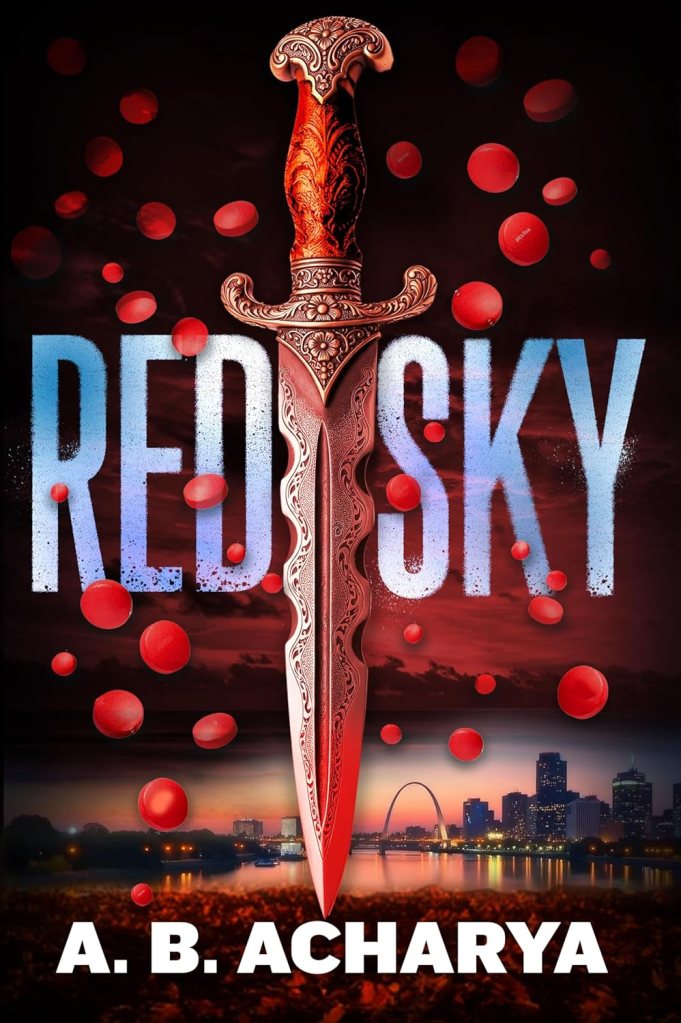
Book Details:
Author: A.B. Acharya
Release Date: 2 March 2026
Series: Juggernaut Series (Book #1)
Genre: Medical Conspiracy Thriller
Format: E-book
Pages: 334 pages
Publisher: –
Blurb:
He came to fix the world’s most dangerous drug. The drug had other plans.
Narin Roy is writing his confession in a police interrogation room, and the only thing keeping him calm is the drug that started it all.
Months earlier, he was a disgraced scientist with one shot left: a job at Harvester Pharmaceuticals, developing a therapeutic version of DMTA, the compound behind Red Sky, the street drug that can make you brilliant but occasionally turns you into a killer. Narin has a secret weapon: a formula on a flash drive that could crack the problem no one else has solved. All he has to do is survive Harvester long enough to use it.
But Harvester is not what it appears. Behind its gleaming façade, Narin finds himself caught between a charismatic lawyer whose charm conceals a ruthless agenda, an embittered scientist who built the company and may be destroying it, and a project so classified that its true purpose makes his blood run cold. Meanwhile, a mysterious figure haunts his dreams, a desert prince who trains him for a battle he doesn’t yet understand.
As the weeks pass, Narin can’t tell anymore where the science ends and his unraveling begins. The voices may be hallucinations. The visions may be warnings. And the confession he’s writing, the one that brought him to this cold interrogation room, may not end the way anyone expects.
Red Sky is a propulsive psychological thriller for readers who like their conspiracies dark, their narrators unreliable, and their endings earned.
Review
Red Sky by A.B. Acharya is a strange, cerebral, darkly funny psychological thriller that begins inside a police interrogation room and then spirals backward through grief, ambition, pharmaceutical corruption, academic failure, obsession, hallucination, and murder. The novel is written as the confession of Narin Roy, a thirty-year-old pharmacology researcher whose life unravels after his work on DMTA, the street drug known as Red Sky, pulls him into the orbit of Harvester Pharmaceuticals, Ian Blair, Maru Chandra, Morey Whitely, and Sophie Whitely.
What makes the book immediately compelling is Narin’s voice. He is precise, awkward, resentful, brilliant, self-pitying, funny, frightening, and oddly vulnerable. The narration works because it never allows the reader to feel fully stable. Narin is telling us everything, but we are never entirely sure how much of what he understands is true, distorted, drug-altered, or self-serving. His scientific explanations of Red Sky, the “switch,” Type I and Type II receptors, and his proposed drug breakthrough give the novel a strong speculative-scientific foundation, but the real tension lies in watching how his intellect becomes both his gift and his trap.
The book is at its best when it blends science with psychological horror. The pharmaceutical world of Harvester is particularly effective, Ian’s charisma, Maru’s hostility, Morey’s volatility, and the strange corporate machinery around DMTA make the company feel less like a workplace and more like a trap waiting to close.
Narin’s relationships give the book its emotional complexity. His scenes with Deepa are especially strong because they reveal the fragile, emotional side beneath his arrogance and alienation. His complicated attachment to Sophie is more unsettling than romantic, and that is exactly what makes it work. Ian, meanwhile, is one of the novel’s most intriguing figures: manipulative, generous, damaged, theatrical, and entangled in the very tragedy Narin is trying to explain.
Thematically, Red Sky is rich and unsettling. It explores the seduction of “fixing” the human mind, the ethics of pharmaceutical ambition, the loneliness of immigrant expectation, academic exploitation, mental illness, addiction, masculinity, obsession, and the dangerous fantasy of becoming exceptional enough to justify everything. The drug itself becomes more than a plot device. Red Sky is a metaphor for clarity that may be delusion, transcendence that may be destruction, and happiness that may be chemically engineered at the cost of reality.
That said, this is not a light or fast thriller. The novel is long, intensely interior, and often digressive. Narin explains, analyzes, doubles back, rationalizes, and frequently disappears into scientific, personal, or philosophical tangents. For readers who prefer tight, plot-driven suspense, the pacing may feel demanding. However, for readers who enjoy unreliable narrators, morally murky speculative fiction, and psychological thrillers that let the mind itself become the crime scene, the density is part of the experience.
Overall, Red Sky is an ambitious, intelligent, and unsettling novel. It combines speculative neuroscience, corporate conspiracy, psychological horror, immigrant family drama, and noir-like confession into something distinctive and difficult to categorise. It is messy in places, but deliberately so; its instability mirrors Narin’s own fractured mind. This is a book for readers who like their thrillers dark, intellectual, uncomfortable, and psychologically strange.


I love reading your comments, so please go ahead…