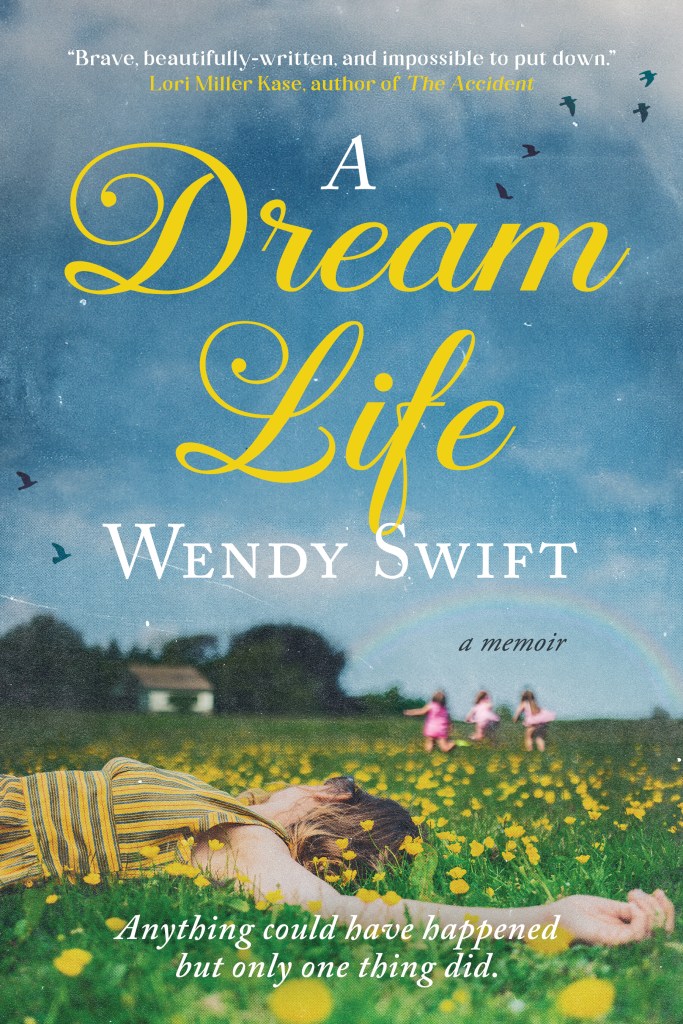
Book Details:
Author: Wendy Swift
Release Date: 21 April 2026Series:
Genre: Memoir
Format: E-book
Pages: 296 pages
Publisher:
Blurb:
When Wendy Swift discovers a letter demanding nearly two million dollars in restitution from her attorney husband, she realizes that her life as a suburban stay-at-home mother has been built on illusion. Despite mounting evidence to the contrary, she believed the quintessential dream life she shared with her husband and three daughters was secure and enduring. A Dream Life traces Swift’s search for validation through marriage, motherhood, and social mobility, and the unraveling that follows.
After her husband begins his incarceration in the 1990s, Swift becomes solely responsible for supporting her three young daughters as they navigate loss, shame, and uncertainty. Her path forward is uneven and hard-won, revealing resilience, reflection, and growth, as well as the perils of blind materialism.
This powerful memoir illuminates the complex challenges families face when confronted with addiction, mental illness, and incarceration. Swift blends unflinching truth-telling with wry self-reflection, awakening readers to the consequences of denial and the restorative power of self-possession. A Dream Life ultimately affirms that anyone can unknowingly fall prey to false beliefs, but once the truth is revealed and the fear of dislocation and upheaval is faced, renewal and strength can emerge.
“A brutally honest portrayal of the emotional, psychological, and economic struggle to keep one’s family intact while enduring the acute financial betrayal and emotional abuse of a rogue spouse.”
— Lisa Lawler, Founder of The White-Collar Wives Project
Review
A Dream Life by Wendy Swift is an intimate, unflinchingly honest memoir about the slow collapse of a marriage built on hope, denial, love, dependency, and illusion. The story begins as a story of young romance and college life, marriage, motherhood, a home in Connecticut, children, friendships, community, and the promise of an upwardly mobile life, gradually reveals itself as something much darker: a portrait of addiction, financial betrayal, emotional evasion, and the painful awakening of a woman who has spent years believing that if she simply holds everything together, the dream might still survive.
What makes this memoir so compelling is author Swift’s refusal to write from a place of easy hindsight. She does not present her younger self as foolish, nor does she flatten Danny into a simple villain. Instead, she reconstructs the emotional logic of each stage of her life with remarkable clarity: the longing to be loved, the desire for a beautiful family, the seduction of status and suburban stability, the acceptance of warning signs, and the slow, almost imperceptible way denial becomes a survival mechanism. The result is a layered examination of how people participate in their own illusions before they are ready to see the truth.
Author Swift’s prose is one of the strongest aspects of the book. It is direct, reflective, and often devastating. She has a gift for grounding emotional complexity in physical detail that accumulate until the reader understands that the “dream life” was never one single lie, but a carefully maintained arrangement of small evasions, financial improvisations, emotional silences, and desperate hopes.
The memoir is especially powerful in its treatment of motherhood. Author Swift’s love for her daughters is the emotional spine of the book, and her struggle is not only to survive Danny’s choices, but to protect the lives of Julia, Erika, and Alli from being destroyed by them. There is no easy heroism here. She is exhausted, afraid, sometimes complicit, sometimes angry, sometimes paralysed, but always trying to preserve some form of safety and normalcy for her children. That honesty makes the memoir far more moving than a polished story of triumph would have been.
The book also offers a sharp portrait of financial abuse and white-collar crime from the inside of the family home. What is chilling is not only the scale of Danny’s betrayals, but the ordinariness surrounding them: school events, dinners, synagogue services, house repairs, tennis lessons, grocery shopping, and children’s routines continue while the foundations of the family are quietly eroding. Swift captures how economic deception does not merely damage bank accounts; it damages trust, identity, self-worth, and one’s sense of reality.
If I had one reservation, it is that the memoir is expansive and sometimes deeply detailed, particularly in the early domestic sections. Some readers may feel the pace is slow before the full magnitude of the crisis emerges. However, I also think this gradualness is part of the book’s design. Swift wants us to understand the dream before we witness its destruction. Without the ordinary texture of the marriage, the suburban life, the friendships, and the children’s childhoods, the later collapse would not carry the same emotional weight.
Ultimately, A Dream Life is a brave, intelligent, and deeply humane memoir about illusion, betrayal, self-forgiveness, and the long road back to agency. It is not only about losing a dream life; it is about learning to distinguish between the life one performs, the life one endures, and the life one finally chooses. Painful, reflective, and empowering, this is a memoir that will resonate especially with readers interested in women’s lives, marriage, addiction, financial betrayal, and the difficult work of reclaiming the self.


I love reading your comments, so please go ahead…